US Navy body fat calculator
The Navy tape method estimates body fat from your height and a few circumferences: the neck and the abdomen at the navel for men, and the neck, the narrowest waist and the hips for women. This page runs the equations of Hodgdon and Beckett (1984) exactly as DoD Instruction 1308.3 prints them, in inches.
Estimated body fat, US Navy method
Choose female or male and enter your measurements.
The 1984 study gives an estimate, not bands. Each military service sets its own limits by sex and age.
- Fat mass
- Lean mass
- Waist-to-height with this waist (ratio)
- Under 0.55, the 2026 military screening limit.At 0.55 or over, the 2026 military screening limit. The Army measures this waist at the navel, so your screen number may differ.

Save this measurement in Leano and watch it change on your own 3D twin.
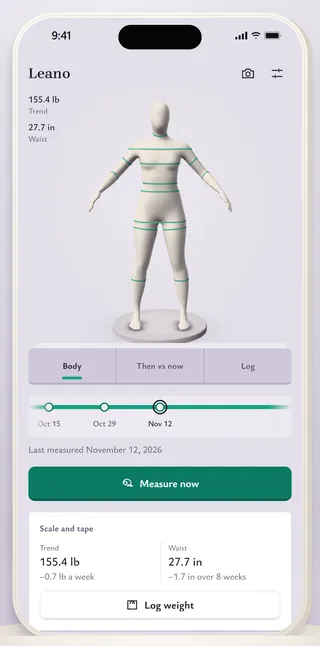
Track it over time with a 3D body twin
One number is a snapshot. Leano, our iPhone app, keeps every tape reading and turns it into a 3D figure shaped by your own measurements, so you can see where your body changed between two dates, not just that it did.
- Guided measuring: the twin lights up where the tape goes, for up to 14 places.
- A US Navy body fat estimate from your neck, waist and hips, beside the waist-to-height ratio.
- Then vs now lays an earlier session over today as a ghost, part by part.
- Everything stays on your iPhone. No account, no ads.
Leano is an iPhone app. Free to download, with an optional Pro upgrade.
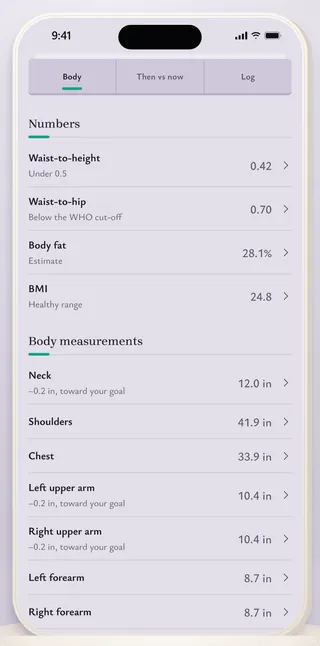
How to measure for the Navy method
- Height: no shoes, heels together against a wall, looking straight ahead.
- Neck: just below the Adam’s apple, the tape at a right angle to the neck and sloping slightly down to the front. Do not flare the neck.
- Men, abdomen: level with the navel, after a normal breath out, without pulling the stomach in.
- Women, waist: at the narrowest point of the abdomen, after a normal breath out.
- Women, hips: around the widest part of the buttocks, with the feet together.
- Measure each place three times and use the average. The tape sits on bare skin, snug without pressing in.
The equations
All lengths in inches, logarithms to base 10.
Men: %BF = 86.010 × log(abdomen − neck) − 70.041 × log(height) + 36.76
Women: %BF = 163.205 × log(waist + hips − neck) − 97.684 × log(height) − 78.387
Centimetres are converted to inches before the equations run, so a metric entry gives exactly the result of the same body in inches. Some calculators use a separate metric version of the formula, which is why two sites can differ by a few tenths.
How far to trust the number
Hodgdon and Beckett built the equations at the Naval Health Research Center in 1984, against underwater weighing of Navy men and women. Like every tape method, the result is an estimate for a group of people, and for one person it can be off by several percentage points. Muscular necks lower the estimate, and a belly measured too high or too low moves it a lot.
What a tape does well is repeat itself. Measured the same way each time, the trend over weeks tells you more than any single reading.
The tape test after 2026
Since a Defense Department memo of December 2025, published in January 2026, every service screens first with the waist-to-height ratio: under 0.55 passes. Members at 0.55 or over are tested further against their service's body fat standard. The Army has replaced its tape test with the ratio altogether, so check your own service's current guide for the second step.
Questions
Short answers, with the source behind each one in the list below.
How accurate is the Navy body fat calculator?
It is an estimate. The equations were fitted against underwater weighing in 1984, and for one person the result can be off by several percentage points. Measuring the same way each time makes the trend reliable even when the single number is not.
Why do other calculators give a slightly different number?
Some use a separate metric version of the Navy formula, and some round the measurements first. This page converts centimetres to inches and runs the equations as DoD Instruction 1308.3 prints them, so a metric and an inch entry of the same body give the same result.
Where do men measure the waist for the Navy method?
Around the abdomen, level with the navel, after a normal breath out. Women measure the waist at its narrowest point instead, and add the hips.
Does the military still use the tape test?
Since January 2026 every service screens first with the waist-to-height ratio, and only members at 0.55 or over are tested further. The Army has dropped its tape test. Each service publishes its own procedure for the second step.
Why do women need a hip measurement?
The women’s equation from the 1984 study uses waist plus hips minus neck, because women carry more fat at the hips. The men’s equation uses the abdomen minus the neck.
Is anything I type saved or sent?
No. The numbers stay on this page in your browser. Nothing is stored or sent, and the page address does not change as you type.
Sources
- Hodgdon JA, Beckett MB. Prediction of percent body fat for U.S. Navy men and women from body circumferences and height. Naval Health Research Center, reports 84-11 and 84-29 (1984).
- US Department of Defense. DoD Instruction 1308.3, DoD Physical Fitness and Body Fat Programs Procedures: the circumference equations in inches.
- US Department of Defense. Additional guidance on military fitness standards, memo of 18 December 2025, published 12 January 2026.
- Task & Purpose. Report on the move to the waist-to-height ratio across the services, 12 January 2026.
- US Army. Army modifies body composition program, adopts waist-to-height ratio, 7 July 2026.
Formulas, limits and links checked 20 November 2026.