Waist-to-height ratio calculator
Type your height and your waist. Under 0.5 means your waist is less than half your height, the line NICE draws for adults. Since January 2026, 0.55 is also the body composition limit for every US military service.
Your waist-to-height ratio
Enter your height and waist to see your ratio.
NICE sets no band below 0.4. BMI and a doctor can say more about a low ratio.
NICE: no increased health risks from fat around the middle.
NICE: increased health risks.
NICE: further increased health risks.
- Waist at half your height (0.5)
- Waist at the military limit (0.55)
- Under 0.55: you pass the first step of the 2026 military screen.At 0.55 or over: the 2026 military screen would test you further.
- Body fat from the same two numbers (RFM)
- Choose female or male above for a body fat estimate from the same two numbers.

Save this measurement in Leano and watch it change on your own 3D twin.
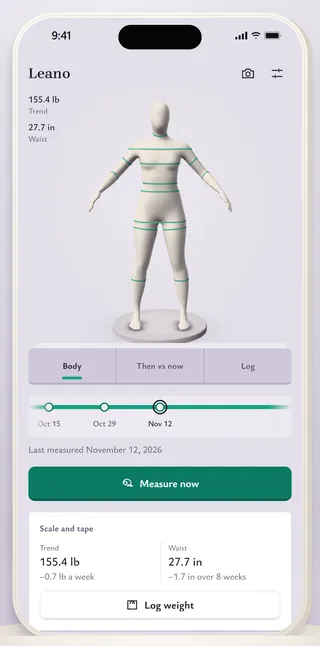
Track it over time with a 3D body twin
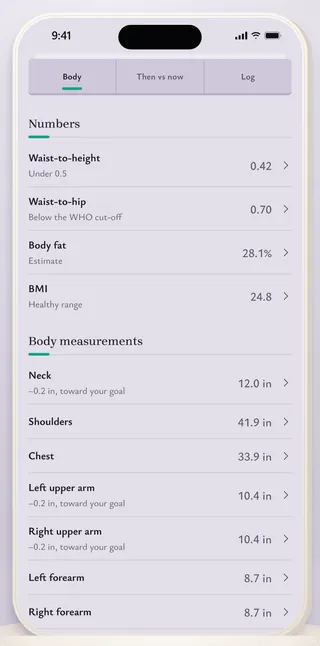
One number is a snapshot. Leano, our iPhone app, keeps every tape reading and turns it into a 3D figure shaped by your own measurements, so you can see where your body changed between two dates, not just that it did.
- Guided measuring: the twin lights up where the tape goes, for up to 14 places.
- The waist-to-height ratio and a body fat estimate update after every measurement.
- Then vs now lays an earlier session over today as a ghost, part by part.
- Everything stays on your iPhone. No account, no ads.
Leano is an iPhone app. Free to download, with an optional Pro upgrade.
How to measure your waist for this ratio
- Measure your height first: no shoes, heels against a wall, looking straight ahead.
- At your side, find the bottom of your lowest rib and the top of your hip bone.
- Put the tape around your waist midway between the two, level all the way round, on bare skin.
- Breathe out normally and read the tape at the end of the breath. Keep it snug without pressing in.
- Type both numbers. The units switch converts what you have typed, so either unit works.
The ratio has no unit
Waist divided by height gives the same number in any unit, as long as both are in the same one. 34 in over 68 in is 0.50, and so is 86.4 cm over 172.7 cm.
Measuring for a military screen
The US Army takes the waist at the navel, not midway up the side, and divides it by the height in inches. If you are checking yourself against that screen, measure at the navel.
The ratio on this page is shown to two decimals and rounded down, so 0.549 shows as 0.54. The pass line underneath uses the exact division.
What your ratio means
| Ratio | NICE classification | Health risk |
|---|---|---|
| Under 0.4 | Not classified | No band is set |
| 0.4 to 0.49 | Healthy central adiposity | No increased health risks |
| 0.5 to 0.59 | Increased central adiposity | Increased health risks |
| 0.6 or more | High central adiposity | Further increased health risks |
Who these bands are for
NICE uses them for adults with a BMI under 35: men and women, every ethnic background, and people with a lot of muscle. They are not for pregnancy, and children and young people are assessed with tools made for their age.
Why the waist and not only the weight
BMI uses weight and height, so it cannot see where the weight sits. Fat around the middle carries more health risk than the same weight elsewhere, and the waist-to-height ratio picks that up with one tape. Ashwell and Gibson found that the simple 0.5 boundary identified more people at early health risk than a matrix of BMI and waist circumference (BMJ Open, 2016).
A band is not a diagnosis. If your result worries you, a doctor or nurse can tell you what it means for you.
The 0.55 line in the US military
A Department of Defense memo dated 18 December 2025 and published on 12 January 2026 makes the waist-to-height ratio the body composition screen for every service and sets the limit below 0.55. It replaces the old height and weight tables. Members at 0.55 or over are tested further, and those over their service's body fat standard go into its remedial program.
The Army moved first: it measures the waist at the navel, divides by height in inches, and a second team re-measures anyone at 0.55 or over on the same duty day. It has dropped the tape test that estimated body fat.
What this page can and cannot tell you
It does the same division, so it shows where you stand before an official measurement. It is not one: each service writes its own procedure, and only its trained staff can record a result. If you are over the line, the US Navy body fat calculator gives the tape-method estimate many services used as their second step.
The waist at 0.55 in your result is the line itself: your waist has to stay below it to pass.
Questions
Short answers, with the source behind each one in the list below.
What is a healthy waist-to-height ratio?
For adults, NICE calls 0.4 to 0.49 healthy central adiposity. The short rule is to keep your waist to less than half your height. At 0.5 to 0.59 NICE sees increased health risks, and at 0.6 or more further increased risks.
Do I use inches or centimetres?
Either, as long as both numbers are in the same unit. The ratio has no unit: 34 in over 68 in and 86.4 cm over 172.7 cm both give 0.50.
What waist-to-height ratio does the military use?
Below 0.55. A Department of Defense memo of December 2025, published in January 2026, set that limit for every service. Members at 0.55 or over are tested further. The Army measures the waist at the navel.
Is the waist-to-height ratio better than BMI?
They measure different things. BMI cannot see where weight sits, and the waist-to-height ratio looks at the middle, where fat carries more risk. In UK survey data, the 0.5 boundary identified more people at early health risk than a matrix of BMI and waist circumference (Ashwell and Gibson, BMJ Open 2016).
Where exactly do I measure my waist?
The NHS measures midway between the lowest rib and the top of the hip bone, after a normal breath out. The US Army measures at the navel for its screen. Pick one place and use it every time, so your numbers compare.
Can children use this calculator?
The NICE bands are for adults. Children and young people are assessed with measures made for their age, so ask a GP or school nurse about a child.
Is anything I type saved or sent?
No. The numbers stay on this page in your browser. Nothing is stored or sent, and the page address does not change as you type.
Sources
- NICE. Overweight and obesity management, guideline NG246 (2025): identifying and assessing overweight, obesity and central adiposity.
- Ashwell M, Gibson S. Waist-to-height ratio as an indicator of early health risk: simpler and more predictive than using a matrix based on BMI and waist circumference. BMJ Open 2016;6:e010159.
- NHS. Calculate your waist to height ratio: how to measure.
- US Department of Defense. Additional guidance on military fitness standards, memo of 18 December 2025, published 12 January 2026.
- Military Times. Report on the Pentagon memo and the 0.55 limit, 13 January 2026.
- Task & Purpose. Report on the move to the waist-to-height ratio across the services, 12 January 2026.
- US Army. Army modifies body composition program, adopts waist-to-height ratio, 7 July 2026.
- Woolcott OO, Bergman RN. Relative fat mass (RFM) as a new estimator of whole-body fat percentage. Scientific Reports 2018;8:10980 (the body fat line).
Formulas, limits and links checked 20 November 2026.