What the published figures say
No law or standards body sets a size for a catio, and the guides that give one do not agree. These are the figures we could open and read on 12 October 2026, each with its source. Where a guide quoted an authority we could not trace, we left the figure out.
| Source | What it says |
|---|---|
| Catnets, enclosure FAQ | With several cats in a portable enclosure, give each cat a minimum of 2 square metres (about 21.5 sq ft) of space. |
| Catnets, cats per run | If each cat in a cat run has less than 2 square metres, consider a larger run, and let the cats in and out of the house. |
| Catnets, enclosure size | For one cat, a single portable enclosure of 1.2 m or 1.8 m is ideal; for two or more cats, a double or triple. Whatever the size, cats need vertical climbing space, places to hide and a sunny place to rest. |
| Humane World for Animals, fact sheet | Catios range in size and design, from small cat-sized window boxes to large screened-in rooms you can share with your cats. |
| Height | None of these sources gives a height per cat. They ask for climbing space instead, which shelves and a second tier give. |
So the honest answer has two parts. For one cat, a window box is a real catio: it is a lookout and a place in the sun, not a run. For cats that share, the one per-cat figure we found is 2 square metres each, and it comes from an enclosure maker, not a vet body.
Floor area for one to four cats
Here is the 2 square metre figure worked out for each number of cats, with a freestanding catio that meets it. The result column is the tool's own check of each design; open any of them to change the sizes.
| Cats | Area at 2 m² each | Example | Check | In the tool |
|---|---|---|---|---|
| 1 | No published minimum | 4 ft x 2 ft window box: 0.74 m² (8.0 sq ft) | Note | Open it |
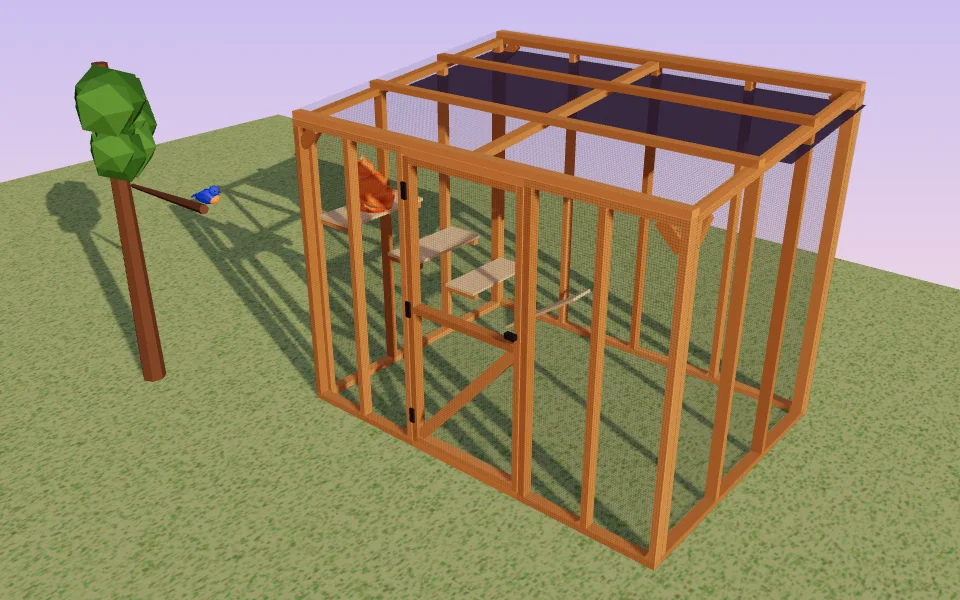
| 2 | 4.00 m² (43.1 sq ft) | 8 x 6 ft freestanding: 4.46 m² (48.0 sq ft) | Fits | Open it |
| 3 | 6.00 m² (64.6 sq ft) | 10 x 7 ft freestanding: 6.50 m² (70.0 sq ft) | Fits | Open it |
| 4 | 8.00 m² (86.1 sq ft) | 12 x 8 ft freestanding: 8.92 m² (96.0 sq ft) | Fits | Open it |
A lean-to on a house wall is often the cheaper way to the same area: one wall is already there. An 203.19999999999996 x 101.59999999999998 ft lean-to gives 2.97 m², which is 1.49 square metres each for two cats (Check). Open the lean-to.
Height: count the shelves, not the feet
Vertical space matters as much as floor area, and the useful measure is how many comfortable steps a cat can climb. The Refined Feline, shelf spacing suggests 12 to 18 in between shelves for older or cautious cats and up to 24 in for young, athletic ones, with less than 24 in across a gap. The tool spaces shelves about 16 in apart and flags any step over the limit for your least agile cat.
| Catio | Shelves | Shelf heights | Step |
|---|---|---|---|
| Window box, 3 ft at the wall | 2 | 9 in, 18 in | 9 in |
| Lean-to, 6 ft at the front | 3 | 16 in, 32 in, 48 in | 16 in |
| Lean-to, 7 ft at the front | 4 | 16 in, 32 in, 48 in, 64 in | 16 in |
For a walk-in catio the tool adds a door for you once the front is at least 66 in (1680 mm) tall. That is a size for people, not cats: it is where a walk-in catio starts to need a real door frame.
Size your own space: choose the type, type the width and depth, and set the number of cats. The space check shows the area per cat against the 2 square metre figure, with its source. Open a two-cat design.