Directive (EU) 2023/970, Article 4
Point factor job evaluation tool, gender-neutral and free
Score each role on skills, responsibility, effort and working conditions with the factor plan from the EU-wide guidelines of March 2026. Roles that land in the same grade form a category of work of equal value, ready for pay gap reporting and pay information requests.
- Factor plan of the EU guidelines (2026)
- Your roles stay in your browser
- Categories in the Pay Gap Report’s format
Three steps
- Add the roles you want to compare, by hand or from a CSV or the Excel template.
- Score each role on fourteen subfactors, reading what each level means. The points add up as you go.
- Read the grades. Roles in the same grade are work of equal value, and the bias checks say what to look at again.
Roles and scores stay on this page. Nothing is uploaded, and closing the tab discards them unless you save the evaluation file.
The sample is a made-up company with 15 roles, scored in full. The template, column by column
Synthetic data: a made-up company with 15 made-up roles, scored in full so you can see every step. One score is deliberately questionable, so that the bias checks have something to find. and add your own roles.
Roles
One row for each distinct job, named as in your payroll. The number of women and men is optional; it powers two of the bias checks.
| Role | Department | Women | Men | Scored | Points | Grade | Actions |
|---|
Score each role
Pick the level that matches what the job requires, not what the person in it brings. Arrow keys move between levels; the reason you note goes into the record.
Grades and categories of equal value
Categories of work of equal value
Article 3(1)(h): workers doing the same work or work of equal value, grouped on objective, gender-neutral criteria. Here, the roles in one grade.
Bias checks
Prompts to look again, with the reason for each. A flag is not proof of bias, and a clean result is not proof of its absence.
Factor plan and grades
The default plan of the EU-wide guidelines: four factors, fourteen subfactors, 1,200 points, ten grades of 120 points.
Pro lets you change the weights, the level descriptions, the subfactors and the grades. A changed weighting needs a strong, documented, gender-neutral reason; the record keeps it.
The record and the files Pro
The evidence an employer keeps, and the categories for the pay gap report and pay information requests.
The PDF holds the factor plan, every level description, the weights, each score with its reason, the grades, the categories, the bias checks and a sign-off block. The CSV has one row for each role and its category.
Add the categories to a payroll export
Drop the payroll export you use for the Pay Gap Report or the Pay Transparency Kit. Each worker’s job title is looked up among these roles, and their grade is added as a category_of_workers column, which both tools pick up on their own. The file stays in your browser.
Everything here runs in your browser: the roles, the scores and any payroll file you merge are never uploaded, and there are no analytics on this page. Close the tab and they are gone.
How the points work
The plan. Four factors and fourteen subfactors, as in the EU-wide guidelines on gender-neutral job evaluation published by the European Commission and the European Institute for Gender Equality in March 2026. By default skills carry 40% of the points, responsibility 35%, effort 15% and working conditions 10%, out of 1,200.
Levels to points. Each subfactor has levels from 0 to 5, and knowledge from 0 to 8, each with a description of what the job requires. Its points are spread evenly over its levels: communication carries 96 points, so each level adds 19.2. A role’s total is the sum over the fourteen subfactors. A worked example.
Grades and categories. Ten grades of 120 points, as in the guidelines’ workbook: grade 1 runs from 0 to 120 points, grade 2 from 121 to 240, and so on. The roles in one grade are treated as work of equal value, a category of workers in the sense of Article 3(1)(h) of the directive.
The bias checks. Weighting that leans on one factor or leaves a subfactor out; subfactors that give every role the same level; a women-dominated role a grade below a men-dominated role it matches on three factor groups; and the ILO guide’s test of whether the subfactors where women-dominated roles score higher weigh less. Roles count as women-dominated at 60% women or more, as in the guidelines’ workbook.
What it does not do for you
It certifies nothing. The directive approves no method, and nor do we. This is a point-factor method designed to be gender-neutral, following the guidelines and the ILO guide. The guidelines say themselves that using them does not certify or guarantee compliance.
Workers’ representatives. Article 4(4) wants the criteria agreed with workers’ representatives where they exist, and national law may give them a formal say: the works council’s consent to a job evaluation system in the Netherlands, co-determination of pay structures in Germany. Involve them before the scores are final.
Review and record. Score the job, not the person in it. Review the results for bias, and write down every decision and its reason. The record is the evidence behind an answer to a pay information request (Article 7), the category gaps in a pay report (Article 9(1)(g)) and a joint pay assessment (Article 10); in a dispute the burden of proof can shift to the employer (Article 18).
Sources: Directive (EU) 2023/970, Articles 3, 4, 7, 9, 10 and 18 and recitals 26 and 31; European Commission and EIGE, EU-wide guidelines on gender-neutral job evaluation and classification: step-by-step toolkit (2026), Tool 5 and the factor and subfactor plan (CC BY 4.0; descriptions shortened); M.-T. Chicha, Promoting equity: gender-neutral job evaluation for equal pay, a step-by-step guide (ILO, 2008), chapters 4 and 7. Last checked 9 October 2026.
What the $99 version writes
A record you can keep as evidence
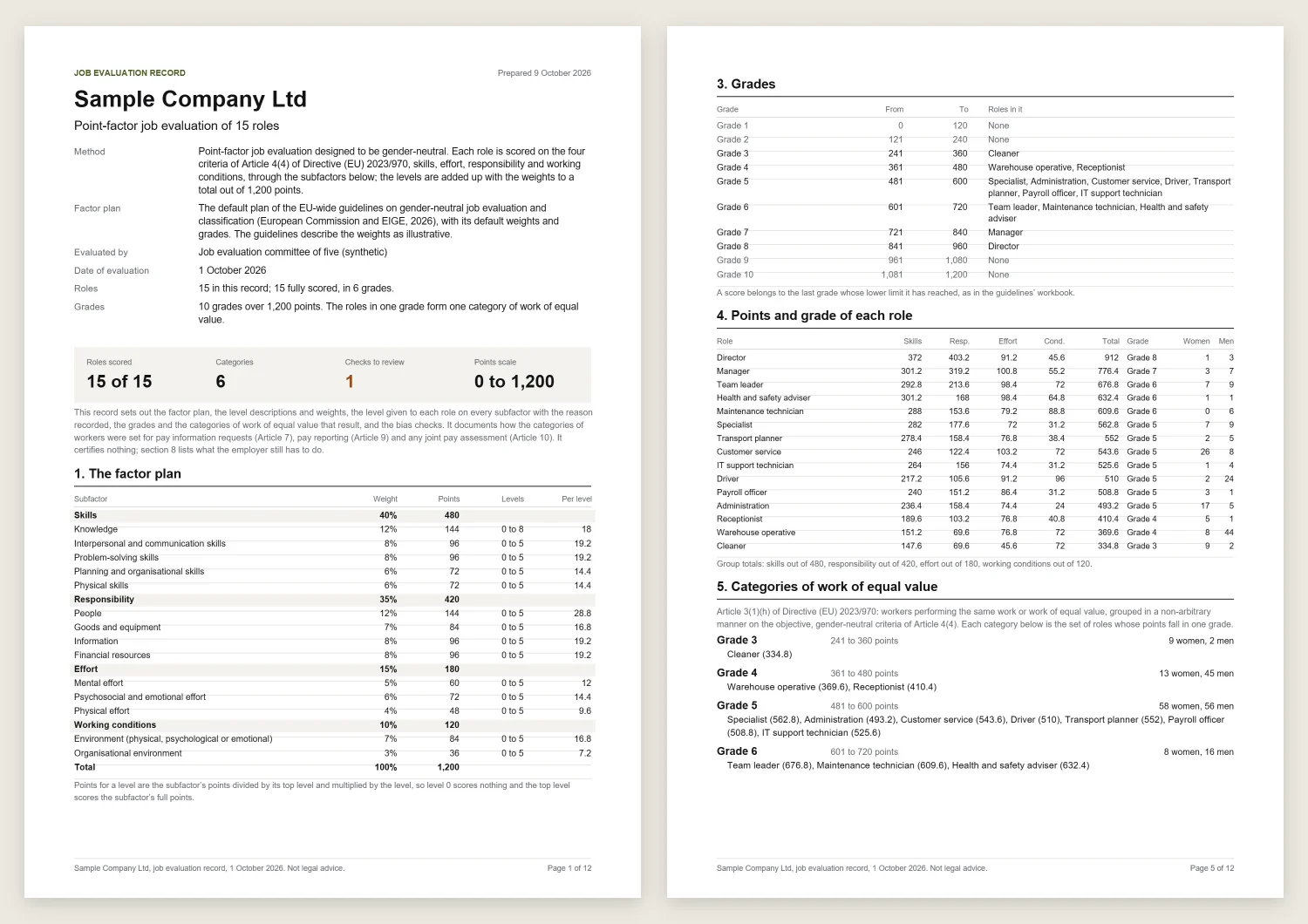
Load the sample company above and the grades fill the page. The PDF below is what Pro wrote for that same synthetic company, in one click.
Free does the evaluation
Up to five roles, on screen.
- The default factor plan, with every level description
- Points, grades and categories of work of equal value
- All four bias checks, with the reasons
- The full sample company, to see every step
Pro keeps it as evidence
For the organisation that has to rely on it.
- Every role, and your own weights, levels, subfactors and grades
- The methodology record PDF, with each score’s reason
- The categories CSV and the payroll merge for the pay gap report
- Save the evaluation as a file and reopen it next year
Pro
The whole evaluation for your organisation
- As many roles as you have, scored with the descriptions in view
- Your own weights, level descriptions, subfactors and grades, with the bias checks on every change
- A methodology record PDF: plan, weights, every score and its reason, grades, categories, checks and sign-off
- The categories CSV, and your payroll export with each worker’s category added for the Pay Gap Report and the Pay Transparency Kit
- One payment; save the evaluation as a file and reopen it for next year’s review
$99 one-time, per organisation
Buy Pro on GumroadGumroad handles payment and refunds. Your key turns on Pro in this browser; enter it again on another computer. The free evaluation stays free.
Questions
Is this a certified or approved job evaluation method?
No. The directive does not certify or approve any method, and neither do we. This is a point-factor method designed to be gender-neutral, built on the factor plan of the EU-wide guidelines and the ILO guide. The guidelines themselves say that using them does not certify or guarantee compliance; that depends on how the evaluation is carried out.
Where do the factors, weights and levels come from?
From the EU-wide guidelines on gender-neutral job evaluation and classification, published by the European Commission and the European Institute for Gender Equality (EIGE) in March 2026: four factors, fourteen subfactors, default weights on 1,200 points and ten grades of 120 points. The guidelines call the weights illustrative. The level descriptions here are shortened from theirs.
Which roles should I evaluate?
Each distinct job, not each person: people doing the same work share one role. Rate what the job requires, not the qualifications or performance of whoever holds it. Use the job titles from your payroll if you want to add the categories to a payroll export later.
What is a category of workers?
Article 3(1)(h) of Directive (EU) 2023/970 defines it as workers performing the same work or work of equal value, grouped in a non-arbitrary way on objective, gender-neutral criteria. Here, the roles whose points fall in the same grade form one category, as the guidelines suggest. The categories decide which averages a worker receives on request (Article 7) and the gaps reported under Article 9(1)(g). Work of equal value, with examples.
Do workers’ representatives have to be involved?
Article 4(4) says the criteria are agreed with workers’ representatives where such representatives exist, and Article 3(1)(h) mentions their cooperation in grouping workers in accordance with national law. National law may also give them a formal say: in the Netherlands the works council must consent to a job evaluation system, and in Germany the works council co-determines pay structures. Involve them before the scores are final.
Is anything uploaded?
No. The roles, scores and any payroll file you merge are processed by this page in your browser. Nothing is sent to a server and closing the tab discards it, unless you save the evaluation file to your own computer. With Pro, only the licence key is sent to Gumroad to check it.
Does it work for equal value claims in the UK?
The Equality Act 2010 treats work as equal when it is rated as equivalent by a job evaluation study (section 65(4)), and a tribunal must accept a study’s different values unless it suspects the study discriminates because of sex or is otherwise unreliable (section 131(6)). Whether an evaluation counts as such a study depends on how it was carried out, so the record of the scheme, the scores and the reasons matters.
What does Pro include?
For $99, once, per organisation: as many roles as you need, your own weights, level descriptions, subfactors and grades, the methodology record PDF, the categories CSV, the payroll merge that adds each worker’s category for the Pay Gap Report and the Pay Transparency Kit, and saving and reopening the evaluation as a file.
Job evaluation guides
Not legal advice. The tool adds up the levels you choose with the weights shown; the employer decides the roles, the levels, the weights and the grades, involves workers’ representatives where the law requires it, and is responsible for the pay structure that results.