Design a sim racing cockpit around your body
Sim Rig Designer is a free online sim rig design tool. Enter your height, your seat, your wheel base and your screens, and it builds the rig in 3D, checks your knee, hip and elbow angles against published driving-posture studies, and lists every board, bracket and bolt to buy.
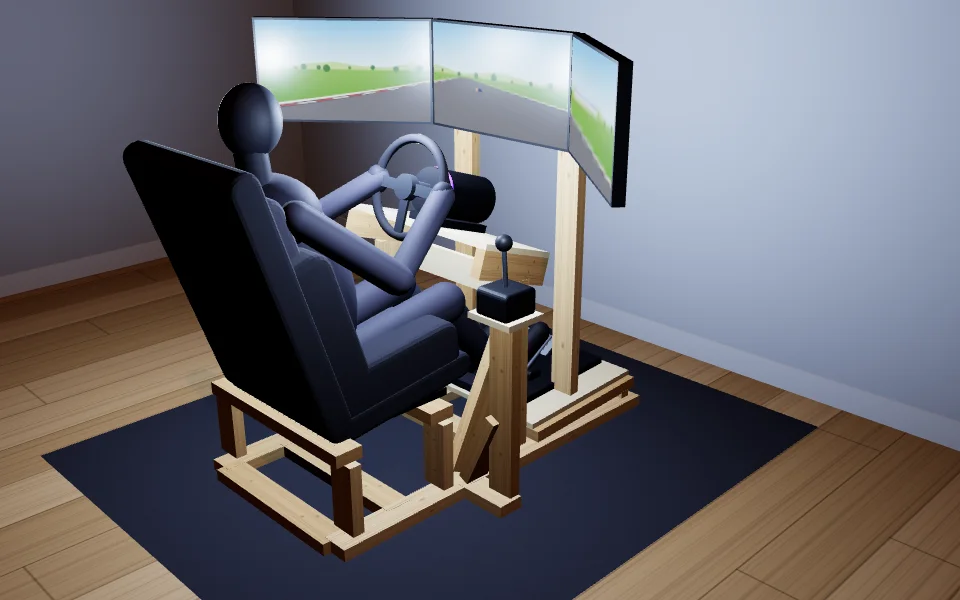 Sample
This browser cannot draw 3D (WebGL is off). The checks and the shopping list below still work.
Sample GT rig
GT and road 2x4 wood rig for a driver 5 ft 9 in tall, bucket seat, direct drive base, three 27 in screens
This is a sample: a 2x4 GT rig with a bucket seat, a direct drive base, load cell pedals, a shifter and three 27 in screens, for a driver 5 ft 9 in tall. Type your own height to make it yours.
The checks, with their sources
Driving-posture studies, SAE J1100 and sim-racing guides, read on 14 October 2026. Where they disagree, each row gives the range and every source.
| Result | Check | Yours | Guide | Why |
|---|---|---|---|---|
| The seat | ||||
| Fits | Seat back angle | 18 degrees from the vertical | 5 to 25 degrees | Inside the 5 to 25 degrees (mean 15.9) that drivers chose in Porter and Gyi's rig; SAE J1100 gives cars a torso angle of 5 to 40 degrees. Fanatec's F1 article gives the backrest about 100 to 110 degrees from the cushion. Porter and Gyi (1998), SAE J1100 (2001), Fanatec, F1 seat position |
| Fits | Heels against the seat (H30) | Hip point 13 5/16 in above the heel | 127 to 405 mm (5 to 16 in) | Inside the 127 to 405 mm (5 to 16 in) SAE J1100 gives for cars. Drivers in Porter and Gyi's rig chose 283 to 335 mm (11 to 13 in), 301 mm (12 in) on average. SAE J1100 (2001), Porter and Gyi (1998) |
| Legs and pedals | ||||
| Fits | Knee angle at rest | 117 degrees | 99 to 138 degrees; 100 to 120 for GT (Fanatec) | Inside the 99 to 138 degrees drivers chose in Porter and Gyi's rig with the accelerator half pressed; Rebiffé gives 95 to 135 and Grandjean 110 to 130. Fanatec suggests about 100 to 120 degrees for GT, with the thighs slanting slightly down. Porter and Gyi (1998), Fanatec, GT pedal position |
| Fits | Knee at full brake | 125 degrees with the brake 18 degrees down | A slight bend left: no straighter than 138 degrees | Fanatec asks for a slight bend in the knee even at full press, in its GT and formula guides; here the knee stays inside Porter and Gyi's comfortable range when the brake is down. Fanatec, GT pedal position, Fanatec, formula pedal position, Porter and Gyi (1998) |
| Fits | Hip angle (torso to thigh) | 96 degrees | 90 to 120 degrees | Inside the 90 to 115 degrees drivers chose in Porter and Gyi's rig, and the 95 to 120 (Rebiffé) and 100 to 120 (Grandjean) they compare with. Porter and Gyi (1998) |
| Fits | Ankle angle (shin to foot) | 95 degrees, pedal deck at 3 degrees | 80 to 113 degrees | Inside the 80 to 113 degrees drivers chose in Porter and Gyi's rig; Rebiffé and Grandjean give 90 to 110. Fanatec: the pedal angle should be like your natural foot angle when driving. Porter and Gyi (1998), Fanatec, GT pedal position |
| Arms and wheel | ||||
| Fits | Elbow angle | 105 degrees at 9 and 3 o'clock | 90 to 120 degrees | Fanatec: elbows bent between 90 and 120 degrees on the wheel; Qubic gets about 90 to 100 from the wrist test (arms straight, shoulders on the seat, wrists on top of the rim). Drivers in Porter and Gyi's road-car rig chose from 86 to 164. Fanatec, F1 seat position, Qubic System, GT seating, Porter and Gyi (1998) |
| Fits | Wheel centre against the shoulder | between chest and shoulder, 2 7/8 in under the shoulder | Chest to shoulder height | Asetek: around chest to shoulder height, with relaxed shoulders. Qubic puts the centre of a GT wheel near the base of the neck. Asetek, wheel position, Qubic System, GT seating |
| Fits | Rim and deck over the legs | 6 5/16 in between the rim and your legs | Clear of the thighs and knees | The bottom of the rim and the underside of the wheel deck clear the top of your thighs, knees and shins, as modelled from your ANSUR II thigh clearance. ANSUR II (2012) |
| The screen | ||||
| Fits | Eyes against the screen | 0 in above the screen centre | Between the centre and the top edge | Asetek: keep your eyes roughly level with the middle of the screen, in racing position. Fanatec, for a desk chair: eyes level with the top of the screen or a little higher. You sit between the two. Asetek, monitor position, Asetek, ergonomics guide, Fanatec, F1 seat position |
| Fits | Rim and the view | The rim top passes 5 1/8 in under your line to the screen centre | The rim under the middle of the screen | You see the middle of the screen over the rim. Asetek: make sure the wheel does not block important on-screen information. Asetek, monitor position |
| Note | Field of view to set in the game | 118 degrees across, 22 degrees high; side screens turned in 40 degrees | For your 27 in triples at 33 7/16 in | Asetek: base the FOV on the screen size and the distance from your eyes. These are the angles the screens cover from your eye point, worked out from the geometry; type the one your game asks for (across or high). The side angle turns each side screen square to your eye. Asetek, monitor position |
| The frame and your room | ||||
| Check | Wheel deck stiffness | Direct drive base on 2x4 posts, braces and a plywood panel between them | No flex under force feedback | No published figure says how stiff a deck must be. Asetek warns that a direct drive base's stronger force feedback can expose flex or instability. The design braces the deck; when it is built, grip the rim and twist hard: if the deck moves, add a brace. Asetek, wheel position, Asetek, ergonomics guide |
| Note | Pedal deck for a load cell brake | Load cell brake | A deck that does not move | A load cell brake is pressed hard (Fanatec: load cell pedals give realistic braking resistance). The deck is cross-braced at the front; bolt the pedals through it, and add a brace behind if it shifts. Fanatec, formula pedal position, Asetek, ergonomics guide |
| Check | Hole patterns | Example patterns for the wheel, pedals, shifter | Your own measurements | The tool knows no maker's bolt pattern. Measure the holes under your gear (the helper shows how), type them in and tick measured; the plates and DXF files use what you type. |
| Fits | Fits your room | 4 ft 4 3/4 in by 3 ft 3 1/4 in with the screen stand | Your space: 7 ft by 8 ft | The rig fits the space you entered. Leave room beside the seat to climb in and out. |
Shopping list
Type the prices from your store to see a total. The tool ships no prices.
| Item | Quantity | Your unit price | Cost |
|---|---|---|---|
| Lumber | |||
| 2x4 x 8 ftActual size 1 1/2 x 3 1/2 in. Pick straight boards with few knots. | 7 boards | ||
| Sheet goods | |||
| 4 x 8 ft plywood, 23/32 inThe decks and plates. | 1 sheet | ||
| Fasteners | |||
| Wood screws, 3 inFour at each joint, plus a tenth spare. Drill pilot holes near the ends. | 232 screws | ||
| Wood screws for the plates and panels, 1 1/2 inEvery fixing hole in the plates, about twelve for each panel, plus a tenth spare. | 33 screws | ||
| Wood glueOn every panel joint and cleat. | 1 bottle | ||
| For the gear | |||
| M8 bolts, washers and nyloc nuts through the seat barsCheck the thread your seat brackets or sliders take. | 4 sets | ||
| VESA brackets for three screens on the barMatch the VESA pattern on the back of your screen. | 3 brackets | ||
| Bolts, washers and nuts for the wheel deck plate (6.5 mm holes)Bolt size to suit the threads in your gear. | 4 sets | ||
| Bolts, washers and nuts for the pedal plate (8.5 mm holes)Bolt size to suit the threads in your gear. | 6 sets | ||
| Bolts, washers and nuts for the shifter plate (6.5 mm holes)Bolt size to suit the threads in your gear. | 4 sets | ||
| Total of the prices you entered | |||
The build plan for this exact rig
Pro turns your design into a plan you can build from: every board or profile cut with its length, the plates as DXF files for a CNC router or a laser cutter, drilling templates to print at full size, and the steps in order with the dimensions.
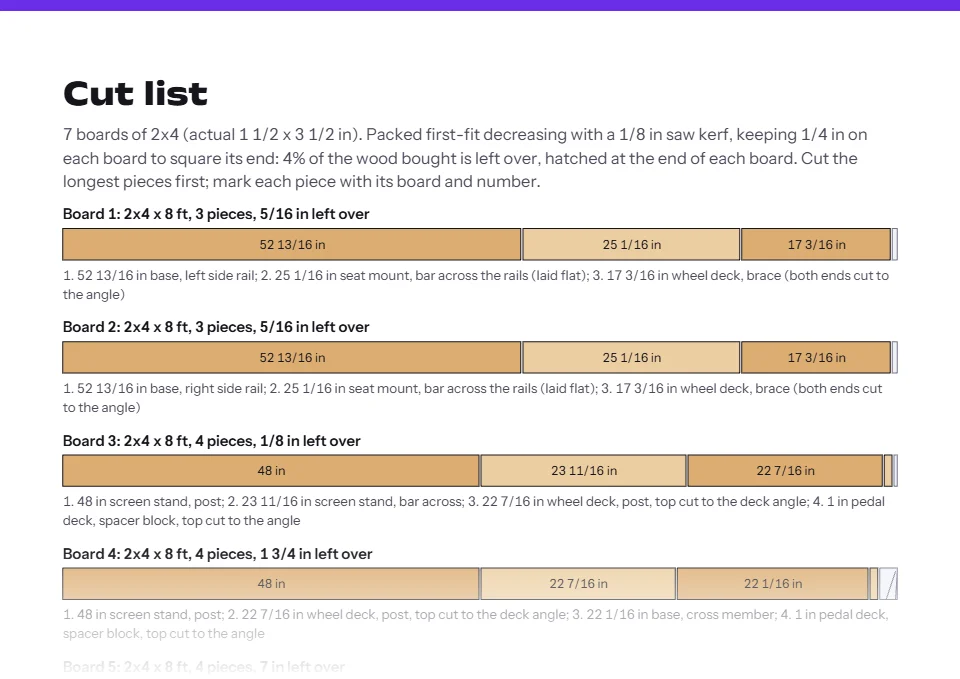
- Optimised cut listEvery board by stock length with its cuts, packed to waste least, a cutting diagram per board and the leftoversPro
- Aluminium bill of materialsEach 40 x 40 and 40 x 80 profile cut by length, to order cut or to cut from 1, 2 and 3 m lengths, with every bracket, T-nut, bolt and end capPro
- DXF files for the platesThe wheel, pedal and shifter plates with your hole patterns and the fixings to the frame, in millimetres or inchesPro
- Step-by-step build plan (PDF)Your fit with every angle, scaled side, front and top views, full-size drilling templates for the gear holes, and an exploded view for each stepPro
- Saved designs and both unitsSeveral designs kept in this browser; the plan in inches and millimetres at oncePro
- 3D files and rendersGLB and OBJ for SketchUp or Blender, and a large picture of your rigPro
Saved designs
$19 once
Buy Pro on GumroadGumroad handles payment and refunds. Your key turns Pro on in this browser.
The plan is guidance for a hobby build, not an engineering guarantee.
Before you build
- DIY sim rig plans in 2x4A GT rig in 2x4 and plywood, every piece and its length
- Aluminum sim rig plans40 x 80 and 40 x 40 profile, cut by cut, with the brackets and T-nuts
- Cockpit dimensions by heightSeat, pedals, wheel and screen for drivers of 155 to 195 cm
- CNC plans for the platesThe wheel, pedal and shifter plates as DXF files, or cut by hand
- Sim Rig selber bauenHolz-Anleitung mit Maßen, auf Deutsch
Questions
What are the right dimensions for a sim racing cockpit?
They depend on your body and on how you sit. For GT and road driving, the 55 drivers in Porter and Gyi's adjustable rig (1998) chose a hip point 283 to 335 mm (11 to 13 in) above the heel and a seat back 5 to 25 degrees from upright; SAE J1100 gives cars 127 to 405 mm. Formula seats sit lower and recline further. Sim Rig Designer places the seat, pedals, wheel and screen for your own height and checks the angles. Dimensions by height and style
What angle should my knees be at in a sim rig?
Fanatec suggests about 100 to 120 degrees for GT, with a slight bend left even at full brake. Drivers in Porter and Gyi's rig chose 99 to 138 degrees; Rebiffé gives 95 to 135 and Grandjean 110 to 130. The tool works the angle out from your leg lengths, at rest and with the brake down.
How high should the steering wheel be?
Asetek: around chest to shoulder height, with your shoulders relaxed and your elbows slightly bent; Qubic puts a GT wheel's centre near the base of the neck. Fanatec gives 90 to 120 degrees at the elbow. In a formula position the wheel may sit higher relative to the torso. The tool also checks that the rim and the wheel deck clear your thighs and knees.
Is a 2x4 sim rig strong enough for a direct drive wheel?
No published figure says how stiff a wheel deck must be. Asetek warns that a direct drive base's stronger force feedback can expose flex in a setup. The tool braces the deck (posts, braces and an apron in wood; 40 x 80 posts with a cross bar in aluminium) and asks you to grip the rim and twist hard once it is built. The 2x4 rig, step by step
Does the tool know my wheel base's bolt pattern?
No. It stores no maker's bolt pattern. A diagram shows how to measure the holes under your base, pedals and shifter, and the plates and the DXF files use exactly what you type; until you tick measured, the checks say the pattern is an example. Cutting the plates
Is anything I enter sent to a server?
No. The design, the checks and the 3D model are worked out in your browser. The share link keeps the design after the # sign, which browsers do not send to servers. If you buy Pro, only the licence key is sent to Gumroad to check it.
Sources
Every figure the tool uses, with the page it comes from, each read on 14 October 2026. Lumber, sheet and profile sizes are facts from the standards and from merchants' listings, without prices. The posture figures are the studies' and the guides', cited, not copied; where they disagree, the checks show the range. The body model is our own linear fit on the ANSUR II public data.
All 21 sources, each read on 14 October 2026
- SAE J1100, Motor Vehicle Dimensions, Surface Vehicle Recommended Practice, revised February 2001 (public copy at law.resource.org): the definitions of H30, L40, L42, L44, L46 and L53, and the two classes of driver seating, Class A (H30 127 to 405 mm, torso angle 5 to 40 degrees) and Class B (heavy trucks and buses: H30 405 to 530 mm, torso angle 11 to 18 degrees) (read 14 October 2026)
- Porter, J.M. and Gyi, D.E. (1998), Exploring the optimum posture for driver comfort, International Journal of Vehicle Design 19(3), 255-266: Table 2, comfortable angles observed in 55 drivers against Rebiffé (1969) and Grandjean (1980); Table 7, the rig dimensions they chose (Loughborough University repository) (read 14 October 2026)
- Fanatec: Best sim racing pedal position for GT sim racing (19 December 2024) (read 14 October 2026)
- Fanatec: What is the best seat position for F1 Sim Racing? (12 November 2024, updated 24 January 2025) (read 14 October 2026)
- Fanatec: Best sim racing pedal position for formula racing (20 December 2024, updated 27 December 2024) (read 14 October 2026)
- Asetek SimSports: Sim Racing Ergonomics, The Complete Guide to Comfort, Control and Performance (14 March 2024, updated 19 August 2026) (read 14 October 2026)
- Asetek SimSports: Sim Racing Wheel Position, Height, Distance and Control (11 August 2026) (read 14 October 2026)
- Asetek SimSports: Sim Racing Monitor Position, Height, Distance and FOV (23 July 2026, updated 8 October 2026) (read 14 October 2026)
- Qubic System: GT proper seating position (5 January 2023, updated 27 November 2025) (read 14 October 2026)
- Anthropometric Survey of US Army Personnel (ANSUR II), 2012: public data for 4,082 men and 1,986 women, published by the Penn State OPEN Design Lab; methods in Gordon et al. (2015), NATICK/TR-15/007 (read 14 October 2026)
- American Softwood Lumber Standard, Voluntary Product Standard PS 20-25 (NIST, January 2025), Table 3, nominal and minimum-dressed sizes of boards, dimension and timbers (read 14 October 2026)
- American Softwood Lumber Standard PS 20-25, section 5.3.1: standard lengths are multiples of 1 ft or 2 ft, as the grading rules specify (read 14 October 2026)
- Structural Plywood, Voluntary Product Standard PS 1-19 (NIST, December 2019): section 5.4 states its grade rules for 1220 by 2440 mm (48 x 96 in) panels; its thickness table lists the 23/32 Performance Category (read 14 October 2026)
- OBI: Rahmenholz Fichte/Tanne gehobelt gefast 45 mm x 70 mm x 2100 mm (also sold at 3000 mm), Güteklasse 1, for interior work (read 14 October 2026)
- Jewson: FSC Regularised Timber Treated Kiln Dried 45 x 70mm (FVRT4570), planed, sold from 2.4 m to 4.8 m (read 14 October 2026)
- Jewson: FSC C16 Regularised Timber Treated Kiln Dried 45 x 95mm (FVRT4595), planed, sold from 2.4 m to 4.8 m (read 14 October 2026)
- MKM: Premium Grade Carcassing, 47mm x 100mm (45mm x 95mm Finish), C24, planed (T003180) (read 14 October 2026)
- Travis Perkins: 18mm x 2440mm x 1220mm Structural Hardwood Plywood (read 14 October 2026)
- OBI: Multiplex Platte Birke 250 cm x 125 cm x 1,8 cm, cut to size in store (Zuschnitt) (read 14 October 2026)
- OBI: MDF-Platte Analog E1 280 cm x 207 cm x 2,2 cm, cut to size in store (Zuschnitt) (read 14 October 2026)
- RS PRO strut profile datasheet (Tubing & Struts): 40 x 40 mm with 8 mm groove, 1.75 kg/m, Ix = Iy = 9.18 cm4 (761-3319); 40 x 80 mm with 8 mm groove, 3.05 kg/m, Ix 70.07 cm4, Iy 16.93 cm4 (761-3325); system lengths of 1 m, 2 m and 3 m (read 14 October 2026)
Not affiliated with any maker, retailer, standards body or university named here.