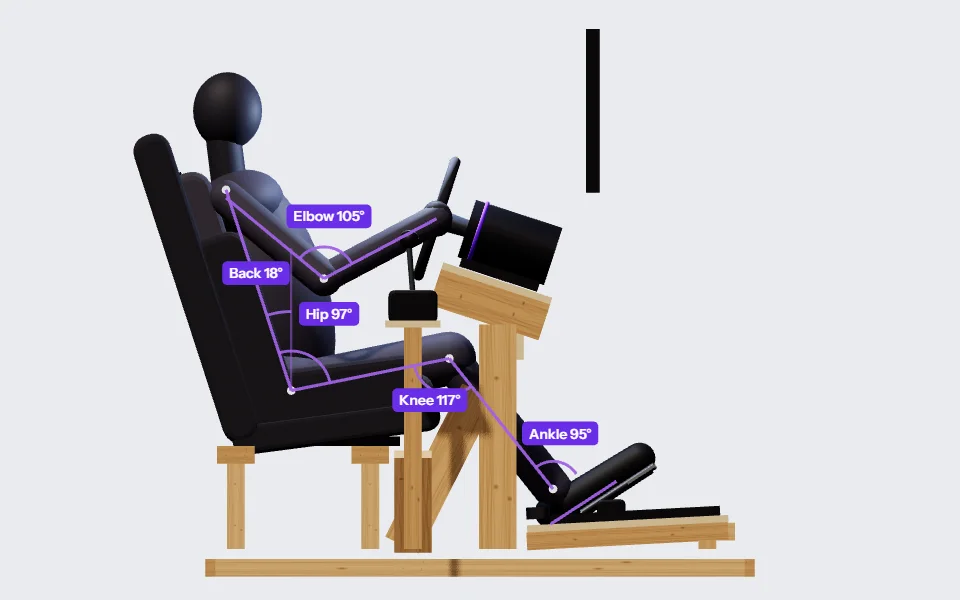
How to read the tables
- Hip point
- The pivot between your torso and your thighs when seated, the point SAE J1100 measures a seat from. It sits a little above and behind the seat cushion's lowest point.
- Heel point
- Where your heel rests on the pedal deck with your foot on the throttle.
- H30
- How high the hip point is above the heel point. It is the number that decides whether you sit like a road car, a truck or a single-seater.
- L53
- How far the heel point is ahead of the hip point. Longer legs need a longer L53 for the same knee angle.
- Seat back
- The back of the seat, in degrees from vertical.
- Wheel centre
- The middle of the rim, given as a height above the hip point and a distance ahead of it.
- Eyes to the screen
- From your eyes to the middle of the screen, straight ahead.
Every row below is a rig the tool built for that body and checked: knee, hip, ankle and elbow angles, the rim and deck clearing the thighs, the wheel against the shoulder and the screen against the eye. All rows pass. Each one has an Open link that loads it, so you can change the seat, the gear or the units and see the numbers move.
GT and road
An upright seat, the heels low on a nearly flat pedal deck and the wheel close. Porter and Gyi's drivers, adjusting a real driving rig to suit themselves, chose a seat back 5 to 25 degrees from upright and a hip point 283 to 335 mm above the heel; Fanatec's GT guide asks for a slight bend in the knee even at full brake.
| Driver | Hip point above the floor | Hip above heel (H30) | Heel ahead of hip (L53) | Seat back | Pedal deck | Knee |
|---|---|---|---|---|---|---|
| 155 cm 5 ft 1 in | 452 mm 17 3/4 in | 294 mm 11 1/2 in | 585 mm 23 in | 18° | 4° | 117° |
| 165 cm 5 ft 5 in | 474 mm 18 3/4 in | 316 mm 12 1/2 in | 621 mm 24 1/2 in | 18° | 4° | 117° |
| 175 cm 5 ft 9 in | 496 mm 19 1/2 in | 338 mm 13 1/4 in | 656 mm 25 3/4 in | 18° | 3° | 117° |
| 185 cm 6 ft 1 in | 518 mm 20 1/2 in | 360 mm 14 1/4 in | 692 mm 27 1/4 in | 18° | 3° | 117° |
| 195 cm 6 ft 5 in | 540 mm 21 1/4 in | 382 mm 15 in | 728 mm 28 3/4 in | 18° | 3° | 117° |
| Driver | Wheel centre above the hip point | Wheel centre ahead of it | Wheel tilt | Elbow | Eyes to the screen | In the tool |
|---|---|---|---|---|---|---|
| 155 cm 5 ft 1 in | 378 mm 15 in | 321 mm 12 3/4 in | 18° | 105° | 788 mm 31 in | Open |
| 165 cm 5 ft 5 in | 406 mm 16 in | 344 mm 13 1/2 in | 18° | 105° | 819 mm 32 1/4 in | Open |
| 175 cm 5 ft 9 in | 435 mm 17 1/4 in | 368 mm 14 1/2 in | 18° | 105° | 849 mm 33 1/2 in | Open |
| 185 cm 6 ft 1 in | 463 mm 18 1/4 in | 390 mm 15 1/4 in | 18° | 105° | 879 mm 34 1/2 in | Open |
| 195 cm 6 ft 5 in | 492 mm 19 1/4 in | 413 mm 16 1/4 in | 18° | 105° | 909 mm 35 3/4 in | Open |
From 155 to 195 cm the heel point moves 143 mm further forward, the wheel centre rises 114 mm above the hip point and the screen moves 121 mm further away, and the hip point rises 88 mm. The angles hardly move: the fitting keeps the knee near 117 degrees and the back at 18, and moves the parts instead.
Formula
The seat low and reclined, the feet high and the pedals steep. Fanatec calls the formula position highly reclined and Qubic System puts formula seat backs closer to 45 degrees; the heels come up toward the hips. The tool keeps the hip point less than 127 mm above the heel, below the least SAE J1100 gives for a car seat, and reclines the back to 40 degrees.
| Driver | Hip point above the floor | Hip above heel (H30) | Heel ahead of hip (L53) | Seat back | Pedal deck | Knee |
|---|---|---|---|---|---|---|
| 155 cm 5 ft 1 in | 280 mm 11 in | 50 mm 2 in | 683 mm 27 in | 40° | 30° | 125° |
| 165 cm 5 ft 5 in | 280 mm 11 in | 50 mm 2 in | 727 mm 28 1/2 in | 40° | 30° | 125° |
| 175 cm 5 ft 9 in | 280 mm 11 in | 50 mm 2 in | 770 mm 30 1/4 in | 40° | 30° | 125° |
| 185 cm 6 ft 1 in | 280 mm 11 in | 50 mm 2 in | 815 mm 32 in | 40° | 31° | 125° |
| 195 cm 6 ft 5 in | 280 mm 11 in | 50 mm 2 in | 859 mm 33 3/4 in | 40° | 31° | 125° |
| Driver | Wheel centre above the hip point | Wheel centre ahead of it | Wheel tilt | Elbow | Eyes to the screen | In the tool |
|---|---|---|---|---|---|---|
| 155 cm 5 ft 1 in | 473 mm 18 1/2 in | 171 mm 6 3/4 in | 28° | 110° | 791 mm 31 1/4 in | Open |
| 165 cm 5 ft 5 in | 486 mm 19 1/4 in | 187 mm 7 1/4 in | 28° | 110° | 825 mm 32 1/2 in | Open |
| 175 cm 5 ft 9 in | 499 mm 19 3/4 in | 204 mm 8 in | 28° | 110° | 858 mm 33 3/4 in | Open |
| 185 cm 6 ft 1 in | 522 mm 20 1/2 in | 218 mm 8 1/2 in | 28° | 110° | 889 mm 35 in | Open |
| 195 cm 6 ft 5 in | 535 mm 21 in | 233 mm 9 1/4 in | 28° | 110° | 921 mm 36 1/4 in | Open |
From 155 to 195 cm the heel point moves 176 mm further forward, the wheel centre rises 62 mm above the hip point and the screen moves 130 mm further away, while the hip point stays at the same height. The angles hardly move: the fitting keeps the knee near 125 degrees and the back at 40, and moves the parts instead.
Rally and truck
The most upright of the three: a tall seat, a flat pedal deck and a wheel tilted further back, closer to a truck cab than a race car. The hip point sits 374 to 486 mm above the heel, from the top of the range SAE J1100 gives for cars into the range it gives for trucks.
| Driver | Hip point above the floor | Hip above heel (H30) | Heel ahead of hip (L53) | Seat back | Pedal deck | Knee |
|---|---|---|---|---|---|---|
| 155 cm 5 ft 1 in | 532 mm 21 in | 374 mm 14 3/4 in | 524 mm 20 3/4 in | 15° | 0° | 112° |
| 165 cm 5 ft 5 in | 560 mm 22 in | 402 mm 15 3/4 in | 555 mm 21 3/4 in | 15° | 0° | 112° |
| 175 cm 5 ft 9 in | 588 mm 23 1/4 in | 430 mm 17 in | 586 mm 23 in | 15° | 0° | 112° |
| 185 cm 6 ft 1 in | 616 mm 24 1/4 in | 458 mm 18 in | 617 mm 24 1/4 in | 15° | 0° | 112° |
| 195 cm 6 ft 5 in | 644 mm 25 1/4 in | 486 mm 19 1/4 in | 649 mm 25 1/2 in | 15° | 0° | 112° |
| Driver | Wheel centre above the hip point | Wheel centre ahead of it | Wheel tilt | Elbow | Eyes to the screen | In the tool |
|---|---|---|---|---|---|---|
| 155 cm 5 ft 1 in | 346 mm 13 1/2 in | 314 mm 12 1/4 in | 30° | 98° | 750 mm 29 1/2 in | Open |
| 165 cm 5 ft 5 in | 375 mm 14 3/4 in | 338 mm 13 1/4 in | 30° | 98° | 780 mm 30 3/4 in | Open |
| 175 cm 5 ft 9 in | 404 mm 16 in | 362 mm 14 1/4 in | 30° | 98° | 809 mm 31 3/4 in | Open |
| 185 cm 6 ft 1 in | 433 mm 17 in | 385 mm 15 1/4 in | 30° | 98° | 838 mm 33 in | Open |
| 195 cm 6 ft 5 in | 462 mm 18 1/4 in | 409 mm 16 in | 30° | 98° | 867 mm 34 1/4 in | Open |
From 155 to 195 cm the heel point moves 125 mm further forward, the wheel centre rises 116 mm above the hip point and the screen moves 117 mm further away, and the hip point rises 112 mm. The angles hardly move: the fitting keeps the knee near 112 degrees and the back at 15, and moves the parts instead.
The screen
At 849 mm from the eyes, the distance in the 175 cm GT row, a 16:9 screen of 27 in fills 39 degrees across, 32 in fills 45 and a 49 in TV 65. Three 27 in screens with their sides turned in 40 degrees fill 118. Asetek's monitor guide puts the screen as close as the wheel allows, with the field of view set in the game to match, so that a corner looks as big on screen as it would through a windscreen.
How the numbers were made
Segment lengths (thigh, shin, torso, upper arm, forearm) come from the ANSUR II survey of 6,068 US Army men and women: the tool scales them with a straight-line fit to your height, and to your inside leg if you give it. Each rig is then sized so the angles land inside the ranges of the style: Porter and Gyi's measured comfort ranges for road driving, Fanatec's and Qubic System's sim-racing guides for GT and formula, and SAE J1100 for where a hip point can sit. The tables use a bucket seat on a wood frame and a 32 in screen; an office chair or an aluminium frame changes the hip point height, and the tool shows by how much.
Fit a rig to your own height