Dropped kerb in Lancashire: the rules and fees
Lancashire County Council charges £290 to apply and wants a parking space at least 4.8 m deep and 2.4 m wide. If it refuses, £145 comes back. The crossing must be at least 10 m from a junction.
Read from Lancashire County Council’s own pages on 11 October 2026. Lancashire, except Blackburn with Darwen and Blackpool, which are their own highway authorities. The district councils decide planning.
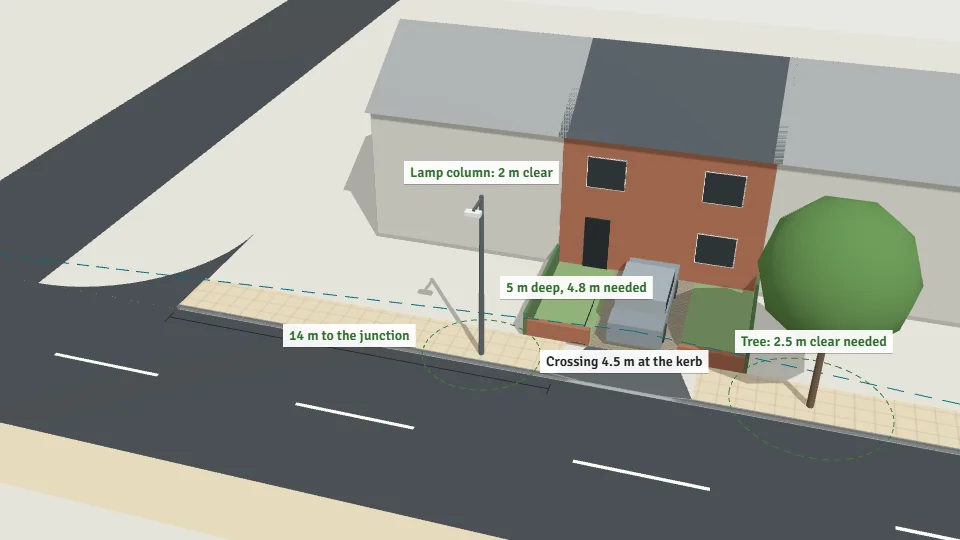
- Fee: Lancashire County Council charges £290 to apply (£145 back if it refuses).
- Space: a parking space at least 4.8 m deep and 2.4 m wide.
- Junctions: at least 10 m from a junction.
- Who builds it: Lancashire uses its approved contractors.
- Decision: The council aims to approve or refuse a standard application within 28 days; longer at busy times.
Lancashire’s rules, one by one
| Rule | What Lancashire asks | Source |
|---|---|---|
| Depth of the space | At least 4.8 m between the back of the footway or the boundary wall, fence or hedge and the front of the building; no part of the car may overhang. Below 4.8 m the council will not consider it. | LCC things to consider, Things to consider, enough space; checklist question 2 |
| Width of the space | At least 2.4 m clear through the whole parking bay for one home; no bay window or tree in it. | LCC things to consider, Things to consider, is the access wide enough |
| The crossing it builds | A standard crossing is 4.5 m at the kerb face and 2.5 m wide for the vehicle; one application covers a joint crossing for two homes up to 6 m. | LCC cost and timescales, Cost and timescales |
| Distance from a junction | Within 10 m of a junction, roundabout or signals on a major A or B road the risk is assessed; on residential streets of 30 mph or less it is unlikely to cause refusal unless there is a specific hazard. Planning permission for the crossing counts in its favour. | LCC things to consider, Things to consider, distance from road junctions; checklist question 4 |
| Seeing along the road | With the driver 2 m back from the carriageway edge: 25 m each way at 20 mph, 43 m at 30 mph, 65 m on a 40 mph residential street (102 m on an A or B road), 158 m at 50 mph, 201 m at 60 mph. Refused without enough visibility. | LCC things to consider, Things to consider, visibility requirements |
| Street trees | Healthy trees are not removed; within 2.5 m of a highway tree trunk the council will not consider the application. | LCC pre-application checklist, Things to consider, obstructions; checklist question 7 |
| Street lights | A street light within 2 m may have to be moved by the council, at your cost (typically £500 to £3,000); you also show you have consulted any neighbour affected. | LCC things to consider, Things to consider, obstructions; checklist question 6 |
| Other street furniture | Telecoms cabinets and other utility furniture: you arrange the move with the owner and usually pay for it. | LCC things to consider, Things to consider, other street furniture |
| Bus stops | May be refused close to a bus stop where the crossing would conflict with waiting passengers or boarding. | LCC things to consider, Things to consider, other highway factors |
| Slopes | The finished drive should fall about 2.5 cm per metre to the kerb, ideally no more than 5 cm per metre; a steep slope to the road can mean refusal. | LCC final things to consider, Final things to consider |
| Pedestrian crossings | May be refused within the zig-zag markings of a controlled crossing, or beside a refuge or island that stops a single turn of more than 90 degrees. | LCC things to consider, Things to consider, other highway factors |
| Parking bays and laybys | Changing parking bays or restrictions takes a traffic order, with its own time and cost; ask the council before applying. | LCC pre-application checklist, Things to consider, existing parking bays; checklist question 11 |
| In front of the door | You must be able to leave the house safely in an emergency with the car parked; the council can refuse or set conditions. | LCC things to consider, Things to consider, enough space; checklist question 3 |
| Gates | Gates may not open outwards over the verge, footway or road, and need room to open with the car parked. | LCC things to consider, Things to consider, gates (Highways Act 1980, s.153) |
| Drainage | Water from an impermeable drive must be dealt with inside the boundary, by a soakaway or storage. | LCC things to consider, Things to consider, drainage |
| Loose gravel | Gravel needs edging or a rigid strip so it stays off the footway. | LCC things to consider, Things to consider, drainage |
| Permission from the owner | Without the freeholder’s written consent the council will not consider the application; land between your boundary and the highway may need an easement. | LCC pre-application checklist, Things to consider, property ownership; checklist question 10 |
What it costs in Lancashire
| What you pay | Amount | Source |
|---|---|---|
| Application feeAn unsuccessful application gets half back (£145). | £290 | LCC cost and timescales |
| Building the crossingContractor quotes for a standard crossing (4.5 m at the kerb, 2.5 m wide for the vehicle, on a 2 m footpath) | £2,000 to £3,500 | LCC cost and timescales |
Lancashire uses its approved contractors. Approved applicants get a list of approved contractors to ask for quotes; your own builder can also apply to be approved, free. The contractor’s Section 171 licence is free with the approval code.
Applying, and what happens next
- The council aims to approve or refuse a standard application within 28 days; longer at busy times.
- The approval is valid for 2 years from the letter.
- A refusal is explained in writing. Half the fee is refunded.
Planning permission in Lancashire
The highway consent and planning permission are separate. Nationally, an access on to an unclassified road and a porous or drained hard surface are permitted development for a house; Lancashire adds:
- Lancashire says access from an A, B or C road may need planning permission, as may connected works such as paving over a garden; get it before applying. (LCC planning permission)
Also worth knowing in Lancashire
- Works by an approved contractor carry a 2-year defect period, after which the council maintains the crossing. (LCC final things to consider)
- A road resurfaced or rebuilt in the last 2 years is protected by a section 58 notice, which can delay the works. (LCC final things to consider)
Questions
Does Lancashire refund the fee if it refuses?
Partly: of the £290, £145 comes back if the application is refused.
Can I use my own contractor in Lancashire?
Approved applicants get a list of approved contractors to ask for quotes; your own builder can also apply to be approved, free. The contractor’s Section 171 licence is free with the approval code.
How long is a Lancashire approval valid?
The approval is valid for 2 years from the letter.
Related
- Check your driveway in 3DEvery rule for your council, in 3D.
- Dropped kerb rules comparedDepth, width, splays, junctions, trees.
- What it costsFees from £55.06 to £500, and the works.
- Manchester rules and feesNo fee published; from £1,575, a space 4.8 m deep.
- Leeds rules and fees£55.06 to apply, a space 5 m deep.
- Sheffield rules and fees£220 to apply, a space 5 m deep.
Sources: Lancashire County Council, Vehicle crossings: main things for consideration before you apply; Lancashire County Council, Vehicle crossings: planning permission; Lancashire County Council, Vehicle crossings: cost and timescales; Lancashire County Council, Vehicle crossings: final things to consider before you apply; Lancashire County Council, Vehicle crossings: pre-application checklist; all read on 11 October 2026. National rules: Highways Act 1980, s.184, GPDO 2015, Part 2 Class B and Part 1 Class F. legislation.gov.uk and GOV.UK content is used under the Open Government Licence v3.0; council figures are quoted as facts with their source, not copied text. Not legal advice and not a decision: the council decides after its own site visit. Not affiliated with any council or government department.