Dropped kerb rules: depth, width, visibility and junctions
To get a dropped kerb, most councils want a parking space 4.75 m to 5 m deep and 2.4 m to 3.5 m wide inside your boundary, the crossing 10 m from a junction, up to 15 m on main roads, nothing above 0.6 m beside the opening, and room round any street tree. The law leaves the detail to each council, so the figures below come from each one’s own pages.
Rules read from 13 councils’ own pages on 11 October 2026.
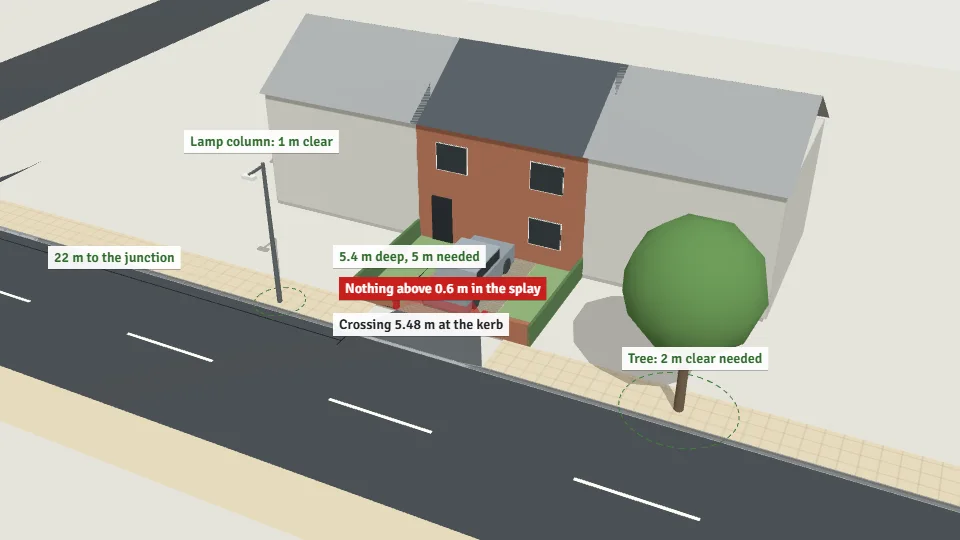
- Depth: 4.75 m to 5 m for a car at right angles; 6 m in front of a garage at Kent, Surrey, Hampshire and Bristol.
- Width: 2.4 m to 3.5 m; Birmingham asks for 2.75 m for one car and 4.5 m for two.
- Junctions: 10 m from a junction, up to 15 m on main roads.
- Visibility: nothing above 0.6 m in a triangle about 2 m each way beside the opening.
- Trees: clearances from 1 m to 2.5 m from the trunk, 4 times the trunk circumference, or 12 times its diameter.
The law behind every council’s rules
Section 184 of the Highways Act 1980 lets anyone ask the highway authority to build a vehicle crossing, and lets the authority approve it, change it, offer something else or refuse. In deciding, it has to think about damage to the footway or verge, safe access and egress, and the flow of traffic. The numbers are each council’s own way of applying that.
| The rule | Where it is in the law |
|---|---|
| Anyone may ask the highway authority to build a vehicle crossing. The authority may approve it, change it, propose other works or refuse, and if it approves it quotes the cost; it must have regard to preventing damage to the footway or verge, safe access and egress, and the passage of traffic (s.184(5)). | Highways Act 1980, s.184(11) to (13) |
| Where a vehicle is habitually driven across a kerbed footway or verge, the authority can serve notice to build a crossing at the owner’s cost or set conditions on its use; knowingly breaking a condition is an offence with a fine up to level 3. | Highways Act 1980, s.184(1) and (17) |
| A gate on premises that opens on a street must not open outwards over it. | Highways Act 1980, s.153(1) |
| The council can require the occupier to stop surface water from the property flowing on to or over the footway. | Highways Act 1980, s.163(1) |
The parking space
| Council | Depth | Width | Parallel |
|---|---|---|---|
| Kent | 4.8 m, 6 m at a garage | 2.4 m | 6 m by 3 m |
| Essex | 5 m | 2.5 m | not published |
| Hampshire | 4.8 m, 6 m at a garage | 2.4 m | not published |
| Surrey | 4.8 m, 6 m at a garage | 2.4 m | 6 m by 2.4 m |
| Hertfordshire | 5 m | 2.7 m | 9.6 m by 3.5 m |
| Lancashire | 4.8 m | 2.4 m | not published |
| Birmingham | 4.75 m | 2.75 m | not published |
| Leeds | 5 m | not published | not published |
| Manchester | 4.8 m | 3.5 m | 6 m by 3 m |
| Sheffield | 5 m | not published | not published |
| Bristol | 4.8 m, 6 m at a garage | 2.4 m | 6 m by 3 m |
| Havering | 4.8 m | 2.4 m | not published |
| Waltham Forest | 4.8 m | 2.5 m | not published |
The depth runs from the back of the footway to the nearest part of the house where the car parks. Surrey counts steps, bay windows and porches, Waltham Forest steps, bays and planters, and Hertfordshire utility cabinets and car chargers as well. Lancashire allows no part of the car to overhang, and Hertfordshire, Havering and Birmingham all say they size the space for a bigger car later, not only the one you own now.
Junctions, visibility and slopes
| Council | Junction | Visibility beside the opening | Slope |
|---|---|---|---|
| Kent | 10 m, up to 15 m | 2 m by 2 m, below 0.6 m | not published |
| Essex | judged on site | not published | not published |
| Hampshire | 10 m, 15 m classified | below 0.6 m, size set on site | 1 in 12 (crossing) |
| Surrey | judged on site | not published | 1 in 12 (crossing) |
| Hertfordshire | 10 m, up to 15 m | 2 m each side of centre, 2 m in, below 0.6 m | 1 in 10 (driveway) |
| Lancashire | 10 m | not published | 1 in 20 (driveway) |
| Birmingham | judged on site | not published | 1 in 10 (driveway) |
| Leeds | not published | not published | not published |
| Manchester | not published | not published | not published |
| Sheffield | 10 m, up to 15 m | not published | 1 in 6 (crossing) |
| Bristol | 10 m, 15 m classified | below 0.6 m, size set on site | 1 in 12 (crossing) |
| Havering | 10 m | not published | not published |
| Waltham Forest | 10 m, 8 m minimum | not published | not published |
Lancashire is the exception on junctions: on residential streets of 30 mph or less it says the distance is unlikely to cause a refusal unless there is a specific hazard. For the view of people on the pavement, Kent keeps a 2 m by 2 m triangle clear above 0.6 m on each side of the opening; Hertfordshire draws its triangle from the centre of the access, 2 m into the drive and 2 m to each side; Hampshire and Bristol keep walls and plants in the visibility areas below 600 mm without fixing their size.
Trees, lamp columns and other street furniture
| Council | Street trees | Lamp columns | Other furniture |
|---|---|---|---|
| Kent | 12 × trunk diameter | 0.5 m | owner decides |
| Essex | tree officer decides | moved at your cost if possible | owner decides |
| Hampshire | 4 × circumference | moved at your cost if possible | owner decides |
| Surrey | 4 × circumference, at least 1 m | 1 m | 1 m |
| Hertfordshire | never within 2 m; assessed inside the root area | 1 m | owner decides |
| Lancashire | 2.5 m from the trunk | 2 m, or moved at your cost | owner decides |
| Birmingham | tree officer decides | 0.45 m | 0.45 m |
| Leeds | tree officer decides | moved at your cost if possible | owner decides |
| Manchester | tree officer decides | moved at your cost if possible | owner decides |
| Sheffield | 4 × circumference | 1 m | 1 m |
| Bristol | tree officer decides | moved at your cost if possible | owner decides |
| Havering | 4 × circumference | 1.5 m, or moved at your cost | 0.45 m |
| Waltham Forest | 2 m from the trunk | 1 m, or moved at your cost | 1 m |
A tree rule written as 4 times the circumference gives a 3.6 m radius for a trunk 0.9 m round; written as 12 times the diameter, it gives 3.4 m for the same tree. Surrey, Hertfordshire, Lancashire and Waltham Forest say healthy street trees are not removed for a dropped kerb, and Manchester that it will not damage a tree for one; Havering removes a tree only on an arboricultural report, Bristol only in exceptional cases, and where Birmingham approves a removal you pay for it and the replanting.
Councils compared
The parking space for one car, in metres
The fee to apply
Questions
What is the minimum depth for a dropped kerb?
Among the councils checked here, 4.75 m to 5 m from the back of the pavement to the house for a car at right angles, and 6 m where the car parks in front of a garage at Kent, Surrey, Hampshire and Bristol.
How close to a junction can a dropped kerb be?
Usually no closer than 10 m, and up to 15 m on main roads or near busy junctions. Hampshire also refuses any crossing within the curved radius kerb of a junction, while Lancashire says the distance is unlikely to matter on 30 mph residential streets unless there is a specific hazard.
Can I get a dropped kerb with a tree outside?
Usually only if the crossing stays clear of the tree’s roots. The councils checked here want at least 1 m to 2.5 m from the trunk, 4 times its circumference, or 12 times its diameter, and several, Surrey, Hertfordshire and Lancashire among them, will not remove a healthy street tree for one.
Related
- Check your driveway in 3DEvery rule for your council, in 3D.
- Planning permissionClassified roads, flats and the 5 m² rule.
- What it costsFees from £55.06 to £500, and the works.
- Refused?The usual reasons, and a review.
- Hertfordshire rules and feesThe centre-line splay and 1 in 10.
- Kent rules and fees£500, and trees at 12 times the diameter.
Sources: Highways Act 1980, s.184; each council’s pages, linked from its own page here; read on 11 October 2026. legislation.gov.uk and GOV.UK content is used under the Open Government Licence v3.0; council figures are quoted as facts with their source, not copied text. Not legal advice and not a decision: the council decides after its own site visit. Not affiliated with any council or government department.