Dropped kerb in Kent: the rules and fees
Kent County Council charges £500 to apply and wants a parking space at least 4.8 m deep and 2.4 m wide. If it refuses, £231 comes back. The crossing must be at least 10 m from a junction (up to 15 m on main roads), with nothing above 0.6 m beside the opening.
Read from Kent County Council’s own pages on 11 October 2026. Kent, except Medway, which is its own highway authority. The 12 district and borough councils decide planning.
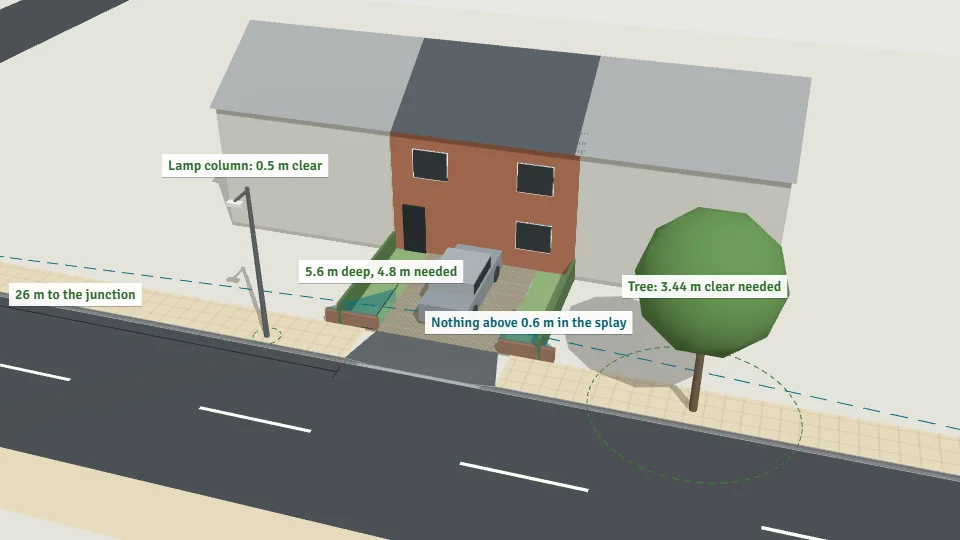
- Fee: Kent County Council charges £500 to apply (£231 back if it refuses).
- Space: a parking space at least 4.8 m deep and 2.4 m wide, 6 m deep in front of a door or garage.
- Junctions: at least 10 m from a junction (up to 15 m on main roads).
- Who builds it: Kent lets you hire your own qualified contractor.
- Decision: The council aims to inspect and decide within 28 days of the application and payment.
Kent’s rules, one by one
| Rule | What Kent asks | Source |
|---|---|---|
| Depth of the space | At least 4.8 m deep and 2.4 m wide for a car at right angles; 6 m deep in front of a door or garage; 6 m by 3 m for parallel parking, or 4.2 m deep with an access point; 5.5 m of clearance where there are gates. | KCC guidance v9, Section 3, space criteria table; section 11, gates |
| Width of the space | At least 2.4 m wide; 6 m for parallel parking. | KCC guidance v9, Section 3, space criteria table |
| The crossing it builds | At least 4 dropped kerbs and 2 tapers for perpendicular parking, at least 6 and 2 for parallel parking; the officer may adjust the size. | KCC guidance v9, Section 3 |
| Distance from a junction | Closer than 10 m to a junction, where it creates a hazard, is refused; the distance can rise to 15 m on major roads or near busy junctions. | KCC guidance v9, Section 5 |
| Walls and hedges beside the opening | A splay of at least 2 m by 2 m from the back of the footway on each side, with nothing above 0.6 m; faster and busier roads may need more. | KCC guidance v9, Section 6, footway visibility |
| Seeing along the road | Where it is in your control, a clear view along the road from 2.4 m back from its edge: 25 m at 20 mph and 43 m at 30 mph. | KCC guidance v9, Section 6, carriageway visibility (from Manual for Streets 2) |
| Street trees | The root protection radius is 12 times the trunk diameter (circumference divided by 3.14) at 1.5 m; the edge of the dropped kerb must be further from the trunk than that. | KCC guidance v9, Section 8, highway tree self-assessment |
| Street lights | A street light or lit sign within 0.5 m needs an engineer’s inspection, may not be movable, and any approved move is at your cost. | KCC guidance v9, Section 7 |
| Other street furniture | Covers, cabinets, poles, hydrants and signs in the area: contact the owner; approval depends on their written agreement. | KCC guidance v9, Section 10 |
| Bus stops | Buses must still pull in and out safely; any relocation is at your cost. | KCC guidance v9, Section 13 |
| Pedestrian crossings | No crossing within 20 m of the stop line of a controlled crossing; a tactile crossing point must be moved at your cost, with a full-height kerb between. | KCC guidance v9, Section 14 |
| Parking bays and laybys | Removing a marked bay needs the district council’s permission and may not be possible; you pay the costs. | KCC guidance v9, Section 12 |
| Traffic calming | Traffic calming will not be removed or adjusted for a dropped kerb. | KCC guidance v9, Section 15 |
| A second crossing | A second access only with a frontage of 15 m by 4.2 m to drive on and off in forward gear, at most 4 flat kerbs each, and 4.5 m of full-height kerb between. | KCC guidance v9, Section 4 |
| Gates | Gates must not open outwards over the highway, and need 5.5 m of clearance. | KCC guidance v9, Section 11 |
| Drainage | The parking area must not drain across the highway; drainage stays within the property. | KCC guidance v9, Section 9 |
| Permission from the owner | If you do not own the property, get the freeholder’s written permission. | KCC guidance v9, Section 1 |
What it costs in Kent
| What you pay | Amount | Source |
|---|---|---|
| Application feeA refused application gets £231 back. | £500 | KCC application page |
| Extra inspection by a tree officer or a street lighting engineer, eachCharged when a specialist has to look at a nearby tree or street light; also for a new access point. | £76 | KCC application page |
| Building the crossingContractors’ prices | £1,000 to £2,500 | KCC application page |
Kent lets you hire your own qualified contractor. Once approved you may use any contractor with New Roads and Street Works Act accreditation for excavation and reinstatement and £5 million public liability insurance.
Applying, and what happens next
- You must send a copy of your planning permission, or written confirmation from your district or borough council that you do not need it.
- The council aims to inspect and decide within 28 days of the application and payment.
- An approval notice is valid for 2 years.
- A refusal letter sets out the reasons; if you think the criteria were applied wrongly you can ask for a review by making a complaint.
Planning permission in Kent
The highway consent and planning permission are separate. Nationally, an access on to an unclassified road and a porous or drained hard surface are permitted development for a house; Kent adds:
- Kent asks for your planning permission, or the district council’s written confirmation that none is needed, with the application. (KCC application page)
Also worth knowing in Kent
- Footway reconstruction: if your road is on the council’s forward works programme you may get a dropped kerb at a reduced rate. (KCC application page)
- A record check on whether an existing dropped kerb is legal costs £76. (KCC application page)
Questions
Does Kent refund the fee if it refuses?
Partly: of the £500, £231 comes back if the application is refused.
Can I use my own contractor in Kent?
Once approved you may use any contractor with New Roads and Street Works Act accreditation for excavation and reinstatement and £5 million public liability insurance.
How long is a Kent approval valid?
An approval notice is valid for 2 years.
Related
- Check your driveway in 3DEvery rule for your council, in 3D.
- Dropped kerb rules comparedDepth, width, splays, junctions, trees.
- What it costsFees from £55.06 to £500, and the works.
- Surrey rules and fees£383 to apply, a space 4.8 m deep.
- Havering rules and fees£261 to apply, a space 4.8 m deep.
- Hampshire rules and fees£211.90 to apply, a space 4.8 m deep.
Sources: Kent County Council, Residential Dropped Kerb Guidance and Self-Assessment, version 9 (April 2026); Kent County Council, Apply for a dropped kerb, extension or access point; all read on 11 October 2026. National rules: Highways Act 1980, s.184, GPDO 2015, Part 2 Class B and Part 1 Class F. legislation.gov.uk and GOV.UK content is used under the Open Government Licence v3.0; council figures are quoted as facts with their source, not copied text. Not legal advice and not a decision: the council decides after its own site visit. Not affiliated with any council or government department.