Do you need planning permission for a dropped kerb?
Usually not, for a house on an unclassified road: the access is permitted development under Class B and the hard surface under Class F, if it is porous or drains to the garden. You need planning permission for an access on to an A, B or C road, for a flat or maisonette, where an Article 4 direction or a planning condition takes the rights away, and for more than 5 m² of impermeable surface that drains to the road.
National rules from the GPDO 2015 on legislation.gov.uk, read on 11 October 2026.
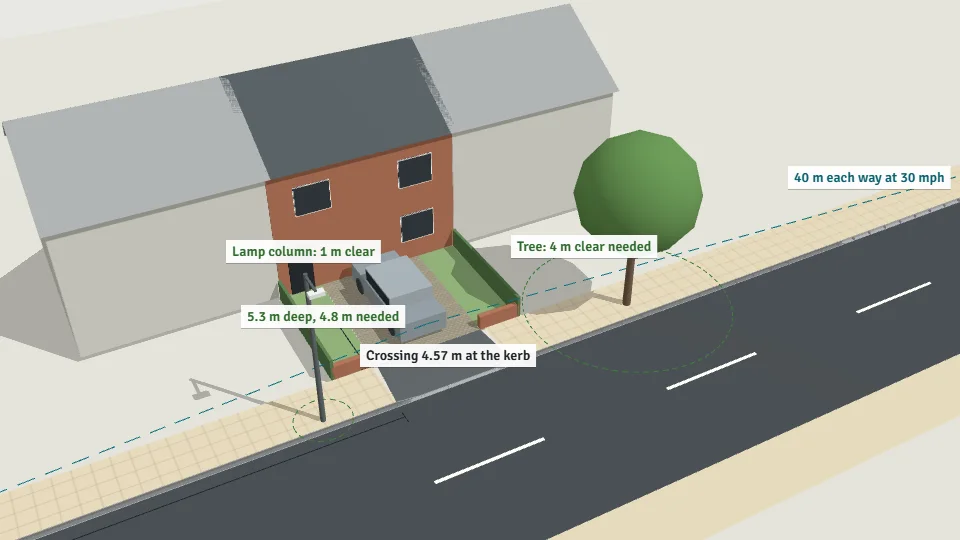
- Classified roads: Class B covers access only to roads that are neither trunk nor classified, so an A, B or C road needs planning permission.
- Flats and maisonettes: Part 1 rights belong to houses, so the hard standing and its access need permission.
- Surface: over 5 m² between the house and the road must be porous, or drain to a porous area.
- Fees: a householder application costs £548 in England from 1 April 2026; a certificate that the work is lawful, £274.
The national rules, from the order itself
| The rule | Where it is in the law |
|---|---|
| A new access is permitted development only on to a road that is neither a trunk road nor a classified road, and only where it is needed in connection with development permitted by another class (such as a Class F hard surface). Access on to an A, B or classified unnumbered road needs planning permission. | GPDO 2015, Schedule 2, Part 2, Class B |
| A hard surface between the front wall of the house and a road that covers more than 5 m², or replaces more than 5 m², must be porous or drain to a porous area within the property. Otherwise it needs planning permission. | GPDO 2015, Schedule 2, Part 1, Class F, paragraph F.2 |
| Part 1 rights belong to houses. A flat, a maisonette or a building containing flats is not a “dwellinghouse”, so its hard standing, and the access for it, need planning permission. | GPDO 2015, article 2(1), “dwellinghouse” |
| Class F does not apply to a house created only under a change-of-use right in Part 3 (Classes G, M, MA, N, P, PA or Q) or built under Part 20. | GPDO 2015, Schedule 2, Part 1, Class F, paragraph F.1 |
| A council can remove permitted development rights for an area by an Article 4 direction; such directions often cover front gardens and walls in conservation areas. | GPDO 2015, article 4 |
| Nothing in the Order permits development contrary to a condition of a planning permission, such as one removing permitted development rights on a newer estate. | GPDO 2015, article 3(4) |
| A new gate, fence or wall next to a road used by vehicles is permitted development up to 1 m high, and not at all within the curtilage of a listed building. | GPDO 2015, Schedule 2, Part 2, Class A, paragraph A.1(a)(ii) and (d) |
| Class A does not cover a gate, fence or wall within the curtilage of a listed building, or one surrounding it, so a new or altered front wall or gate there needs planning permission. Ask the council about listed building consent before any work. | GPDO 2015, Schedule 2, Part 2, Class A, paragraph A.1(d) |
| Development includes engineering operations. Digging out or building up the garden, or new retaining walls, to make a parking area go beyond laying a hard surface under Class F and may need planning permission; ask the council. | Town and Country Planning Act 1990, section 55(1) |
What each council adds
Councils read the same order but say different things about conservation areas and listed buildings. Some list them as needing planning permission outright; others only advise you to ask.
| Council | What it says |
|---|---|
| Kent | Kent asks for your planning permission, or the district council’s written confirmation that none is needed, with the application. (KCC application page) |
| Essex | Essex says an A, B or Class III road needs planning permission before you apply; Harlow and Epping Forest council housing areas also need their own consent. (Essex Highways page) |
| Hampshire | Hampshire refuses a crossing on to an A, B or C road without proof of planning permission. It advises asking the planning authority about impermeable hard standing, conservation areas, listed buildings, flats and maisonettes, non-domestic access and removed permitted development rights. (HCC pre-application checklist) |
| Surrey | Surrey says an A, B or C road needs planning permission, and a D road may. Written evidence from the district or borough council is required either way. (SCC householder guidance) |
| Hertfordshire | Hertfordshire says planning permission is normally needed off an A, B or C road, and for commercial sites, flats or maisonettes; get it before you apply. Letchworth Garden City needs the Heritage Foundation’s consent and Welwyn Garden City the Estate Management Scheme’s, before you apply. (HCC policy v7) |
| Lancashire | Lancashire says access from an A, B or C road may need planning permission, as may connected works such as paving over a garden; get it before applying. (LCC planning permission) |
| Birmingham | Birmingham’s policy says planning permission is required for a flat, maisonette or larger shared house, a listed building or a conservation area, a classified road, a verge that is not highway, or over 5 m² of non-permeable driveway. (BCC policy 2026) |
| Leeds | Leeds says access from an A, B or C road, or across land that is not highway, needs approval from planning services. (LCC vehicle crossing page) |
| Manchester | Manchester says planning permission is required for every dropped kerb on a road that is not unclassified, including its key route network. A new driveway, or removing a wall or fence, may need planning permission too; send the approval with the application. (MCC requirements page) |
| Sheffield | Sheffield says a classified road, a conservation area or a listed building needs planning permission first, except for works Amey does as part of a maintenance scheme. (SCC dropped kerb page) |
| Bristol | Bristol says you need planning permission for a property divided into flats, for removing a gate pillar, wall or fence over 1 m high in a conservation area, for structural work to make the parking area, or on an A, B or C road. (BCC dropped kerbs page) |
| Havering | Havering’s policy says planning approval is needed on a classified road, in a conservation area, for a listed building, and for a flat or maisonette; its website lists the roads that need it. (LBH policy 2023) |
| Waltham Forest | Waltham Forest says planning permission is needed on a classified road, for a listed building, a flat or maisonette, in a conservation area, or for more than 5 m² of non-permeable surface; it can advise when you apply. (LBWF dropped kerbs page) |
Fines, notices and driving over the kerb
Planning and the highway consent are separate, and so are their penalties. Under section 184(1) of the Highways Act 1980 a council can serve notice where a vehicle is habitually driven over a kerbed footway or verge, either to build a crossing at the owner’s cost or to set conditions on its use; knowingly breaking a condition is an offence with a fine up to level 3. Waltham Forest warns that ignoring its formal notice risks a fine of up to £1,000 plus the council’s costs.
Planning enforcement is a separate route: a council can act against a hard surface or access built without the permission it needed.
How to settle it
If the answers above leave a doubt, ask the planning authority, or apply for a lawful development certificate for proposed works: half the householder fee, £274 from 1 April 2026. Kent and Surrey want written confirmation either way with the highway application, and Surrey warns that the district or borough council may charge for it and take up to 6 weeks.
Questions
Do I need planning permission for a dropped kerb on an unclassified road?
Not for a house, as long as the hard surface in front is porous or drains to a porous area and no Article 4 direction or planning condition removes the rights. You still need the highway authority’s consent to build the crossing.
Do I need planning permission to pave my front garden for parking?
Not for up to 5 m², or for any size if the surface is porous or drains to a lawn, border or soakaway (GPDO 2015, Part 1, Class F, paragraph F.2). An impermeable surface over 5 m² that drains to the road needs planning permission.
Can I lower my front wall for a dropped kerb without planning permission?
Usually yes. Lowering a wall is an alteration under Part 2 Class A, which allows a wall next to a road used by vehicles up to 1 m high, or its former height if that was greater. Class A does not cover a wall or gate within the curtilage of a listed building, and an Article 4 direction can remove the right.
Related
Sources: GPDO 2015, Part 2 Class B, Part 1 Class F, Part 2 Class A, article 2, article 3, article 4; TCPA 1990, s.55; Highways Act 1980, s.184; planning fees from 1 April 2026; KCC application page; SCC householder guidance; LBWF application guidance; read on 11 October 2026. legislation.gov.uk and GOV.UK content is used under the Open Government Licence v3.0; council figures are quoted as facts with their source, not copied text. Not legal advice and not a decision: the council decides after its own site visit. Not affiliated with any council or government department.