Dropped kerb in Birmingham: the rules and fees
Birmingham City Council charges £125 for the site inspection and wants a parking space at least 4.75 m deep and 2.75 m wide. The fee is not refunded. If you go ahead, add £375 for the administration fee.
Read from Birmingham City Council’s own pages on 11 October 2026. Birmingham. The city council is both the highway authority and the planning authority.
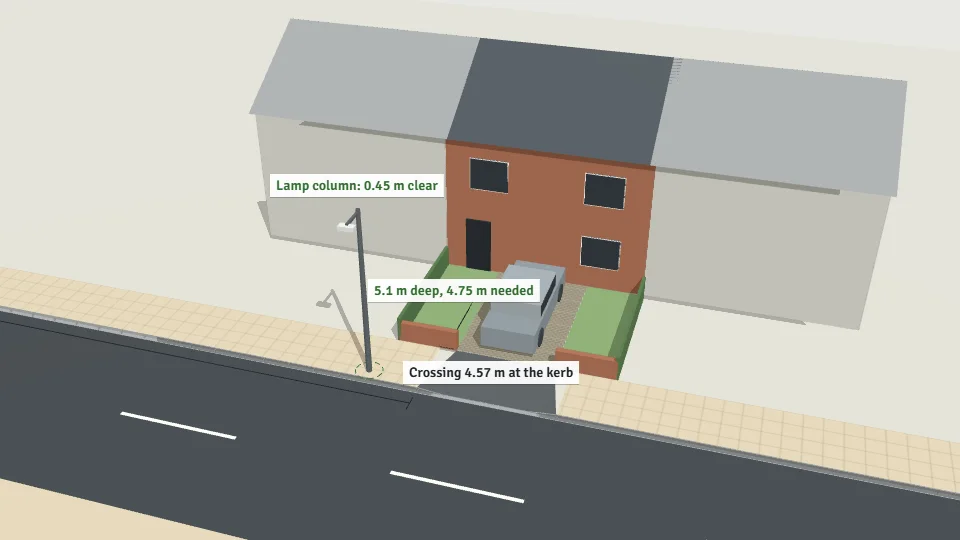
- Fee: Birmingham City Council charges £125 for the site inspection, not refunded, plus £375 for the administration fee.
- Space: a parking space at least 4.75 m deep and 2.75 m wide.
- Junctions: Applications near an existing junction, at or near roundabouts, near traffic signals with regular queues or on fast roads may be refused; no distance is given.
- Who builds it: Birmingham builds the crossing itself.
- Decision: The policy promises a response within 25 days for a standard application; the cost pages expect a quote within 28 working days of the inspection, to accept within 2 months. Installation takes at least 16 weeks after payment, over 20 weeks with trees, utilities or street furniture.
Birmingham’s rules, one by one
| Rule | What Birmingham asks | Source |
|---|---|---|
| Depth of the space | At least 4.75 m from the back of the footway to the furthest-forward part of the property, including retaining walls; smaller frontages are refused. | BCC policy 2026, Policy, A1.2.2; page 3 |
| Width of the space | One car space 2.75 m wide, two spaces 4.5 m. | BCC policy 2026, Policy, A1.2.2 |
| The crossing it builds | The standard crossing is 2.75 m, three dropped kerbs and two tapered kerbs (4.5 m at the kerb edge); narrower is never approved. Combined crossings of 9 m or more need a full-height kerb between them. | BCC policy 2026, Policy, A1.3.1 to A1.3.4 |
| Distance from a junction | Applications near an existing junction, at or near roundabouts, near traffic signals with regular queues or on fast roads may be refused; no distance is given. | BCC policy 2026, Policy, A1.1.4 |
| Seeing along the road | There must be adequate sightlines; reversing on or off may be accepted depending on visibility, traffic and road width. | BCC policy 2026, Policy, A1.1.2 and A1.1.3 |
| Street trees | A healthy, well-established or protected tree nearby is a reason to refuse; a tree officer assesses any nearby tree, which can take 6 weeks or more. If removal is approved you pay for removal and replanting. | BCC policy 2026, Policy, A1.4.4 and A1.4.5; page 3 |
| Street lights | Street furniture or utility equipment more than 450 mm from the works is unlikely to obstruct; lighting columns, signals and crossings inside get a technical assessment, and any move is charged. | BCC policy 2026, Policy, A1.4.2 and A1.4.4 |
| Other street furniture | Street furniture or utility equipment more than 450 mm from the works is unlikely to be in the way; anything nearer gets a technical assessment, and any move is charged. | BCC policy 2026, Policy, A1.4.2 |
| Bus stops | May be refused at a bus stop where it would interfere with passengers or visibility. | BCC policy 2026, Policy, A1.1.4 |
| Slopes | No crossing where the parking area is steeper than 1 in 10 (10 cm of rise or fall per metre). | BCC page 2, Page 2; page 3 |
| Pedestrian crossings | May be refused within the zig-zags of a pedestrian crossing or beside a refuge or island that restricts turning. | BCC policy 2026, Policy, A1.1.4 |
| Parking bays and laybys | Changing yellow lines, red routes, disabled or parking bays is charged and needs a traffic order amendment. | BCC policy 2026, Policy, 6.7 |
| Traffic calming | Changing humps, cushions or tables is charged if approved. | BCC policy 2026, Policy, 6.6 |
| Grass verges | Applications that need a grass verge removed are likely to be rejected. | BCC policy 2026, Policy, A1.4.6 |
| A second crossing | Normally one crossing per property; a second only with a frontage of at least 12 m giving separate entry and exit. | BCC policy 2026, Policy, A1.3.5 |
| Gates | Gates must open inwards (Highways Act 1980, s.153(1)). | BCC policy 2026, Policy, A1.3.7 |
| Drainage | Water must not flow from the property across the pavement; build a permeable hard standing before the crossing. | BCC page 3, Page 3 |
| The drive surface | After approval you must build a suitable permeable hard standing, such as porous tarmac or concrete, slabs or block paving. | BCC page 3, Page 3 |
| Loose gravel | Gravel drives need a 0.5 m strip of solid surfacing at the footway. | BCC policy 2026, Policy, A1.2.7 |
| Permission from the owner | The owner applies; tenants need written permission from the landlord, housing officer or housing association. | BCC policy 2026, Policy, 2.3; page 3 |
What it costs in Birmingham
| What you pay | Amount | Source |
|---|---|---|
| Application fee (inspection)The cost page, updated 1 April 2026, says £125; the apply page, last updated 10 December 2025, still says £113. | £125 | BCC cost page |
| Administration fee, if you go ahead | £375 | BCC cost page |
| Building the crossingPriced for each site from the measurements, materials, labour and traffic management. Blue Badge holders may get a discount on a standard 2.75 m crossing. | quoted for your site | BCC cost page |
Birmingham builds the crossing itself. Only the council can authorise a crossing, and only its authorised contractors build it; you pay in full before work, with no instalments.
Applying, and what happens next
- The policy promises a response within 25 days for a standard application; the cost pages expect a quote within 28 working days of the inspection, to accept within 2 months. Installation takes at least 16 weeks after payment, over 20 weeks with trees, utilities or street furniture.
- Permission is valid for 12 months from approval; an application stays open 1 year after the inspection.
- The policy gives no right of appeal, and the application fee is not refunded.
Planning permission in Birmingham
The highway consent and planning permission are separate. Nationally, an access on to an unclassified road and a porous or drained hard surface are permitted development for a house; Birmingham adds:
- Birmingham’s policy says planning permission is required for a flat, maisonette or larger shared house, a listed building or a conservation area, a classified road, a verge that is not highway, or over 5 m² of non-permeable driveway. (BCC policy 2026)
Also worth knowing in Birmingham
- A white H marking or disabled bay marking can be requested separately. (BCC page 3)
Questions
Does Birmingham refund the fee if it refuses?
No. The £125 is not refunded, so check the frontage against the rules first.
Can I use my own contractor in Birmingham?
Only the council can authorise a crossing, and only its authorised contractors build it; you pay in full before work, with no instalments.
How long is a Birmingham approval valid?
Permission is valid for 12 months from approval; an application stays open 1 year after the inspection.
Related
- Check your driveway in 3DEvery rule for your council, in 3D.
- Dropped kerb rules comparedDepth, width, splays, junctions, trees.
- What it costsFees from £55.06 to £500, and the works.
- Manchester rules and feesNo fee published; from £1,575, a space 4.8 m deep.
- Leeds rules and fees£55.06 to apply, a space 5 m deep.
- Bristol rules and fees£357 to apply, a space 4.8 m deep.
Sources: Birmingham City Council, Apply for a dropped kerb: what is a dropped kerb?; Birmingham City Council, Apply for a dropped kerb: what will my dropped kerb look like?; Birmingham City Council, Apply for a dropped kerb: application requirements; Birmingham City Council, Apply for a dropped kerb: how much will it cost? (updated 1 April 2026); Birmingham City Council, Apply for a dropped kerb: how long will it take?; Birmingham City Council, Apply for a new dropped kerb or extension (updated 10 December 2025); Birmingham City Council, Dropped Crossings Policy (2026), version 3.0; all read on 11 October 2026. National rules: Highways Act 1980, s.184, GPDO 2015, Part 2 Class B and Part 1 Class F. legislation.gov.uk and GOV.UK content is used under the Open Government Licence v3.0; council figures are quoted as facts with their source, not copied text. Not legal advice and not a decision: the council decides after its own site visit. Not affiliated with any council or government department.