Dropped kerb in Bristol: the rules and fees
Bristol City Council charges £357 for the licence and wants a parking space at least 4.8 m deep and 2.4 m wide. The fee is not refunded. The crossing must be at least 10 m from a junction (15 m on a classified road), with nothing above 0.6 m beside the opening.
Read from Bristol City Council’s own pages on 11 October 2026. Bristol. The city council is both the highway authority and the planning authority.
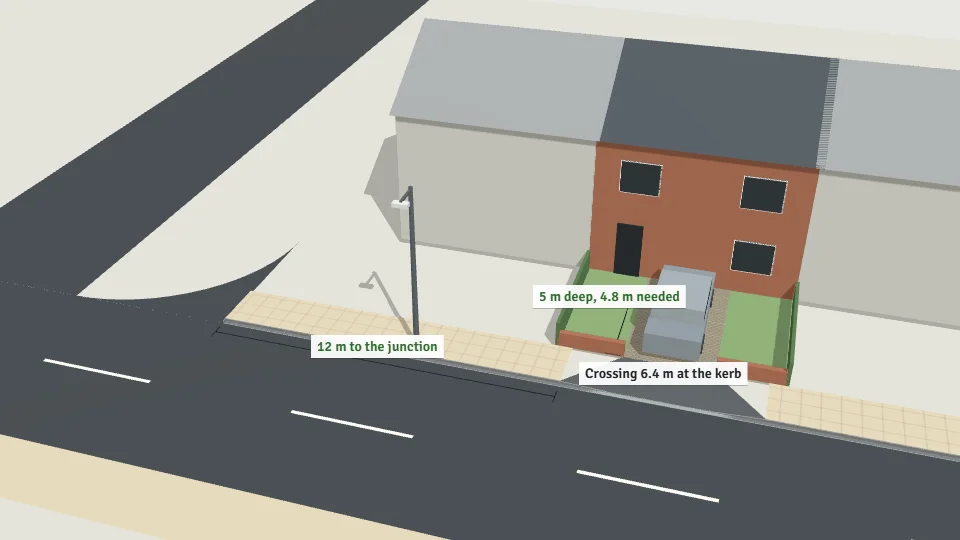
- Fee: Bristol City Council charges £357 for the licence, not refunded.
- Space: a parking space at least 4.8 m deep and 2.4 m wide, 6 m deep in front of a garage with outward-opening doors.
- Junctions: at least 10 m from a junction (15 m on a classified road).
- Who builds it: Bristol lets you hire your own qualified contractor.
- Decision: A highway officer assesses the application and the licences team writes with the decision.
Bristol’s rules, one by one
| Rule | What Bristol asks | Source |
|---|---|---|
| Depth of the space | Without planning permission: straight-in parking at least 4.8 m from the pavement edge to the building, 2.4 m wide (4.8 m for two spaces); parallel 3 m by 6 m. On a classified street, a guide of 5.3 m (4.8 m if not against a building) by 3 m, with no parallel option. In front of a garage with outward doors, 6 m. | BCC dropped kerbs page, Dropped kerbs page, driveway standards; guidance, question 1 |
| Width of the space | At least 2.4 m wide; 6 m for parallel parking; 4.8 m for two cars. | BCC dropped kerbs page, Dropped kerbs page, driveway standards |
| The crossing it builds | The standard is 3 low kerbs and 4 transition kerbs, more where space allows; the transitions start at your boundary and need written consent to pass a neighbour’s. | BCC guidance and process, Guidance, question 4 |
| Distance from a junction | Within 10 m of a junction, traffic signals or a roundabout (15 m on a classified road) the application may be refused on safety grounds. | BCC guidance and process, Guidance, question 2 |
| Walls and hedges beside the opening | Visibility areas must be kept clear, with plants and walls below 600 mm. | BCC guidance and process, Guidance, question 3 |
| Street trees | Near tree roots the officer may ask for a trial excavation at your cost; removal only in exceptional cases with a replacement, also at your cost. | BCC guidance and process, Guidance, question 6 |
| Street lights | A street lamp or furniture blocking access is a reason to refuse; where a move is possible you pay for it. | BCC dropped kerbs page, Dropped kerbs page; guidance, site suitability |
| Other street furniture | Street furniture blocking the access is a reason to refuse; where it can be moved, you pay for it. | BCC guidance and process, Guidance, site suitability |
| Slopes | Gradients must not exceed 1 in 12, preferably 1 in 20; dropped kerbs keep a 25 mm upstand at most. | BCC guidance and process, Guidance, construction |
| Pedestrian crossings | Pedestrian crossings and traffic lights nearby are reasons the council may refuse. | BCC guidance and process, Guidance, question 5; dropped kerbs page |
| Parking bays and laybys | Removing a residents’ parking bay may need a contribution to the traffic order change, made only when the scheme is next reviewed (up to every three years). | BCC guidance and process, Guidance, question 5 |
| Traffic calming | Traffic calming such as speed bumps or build-outs may be moved where possible, at your cost; if it cannot be moved, the licence may be refused. | BCC guidance and process, Guidance, site suitability |
| Turning space on classified roads | On a classified road a car must be able to turn round inside the property and leave in forward gear. | BCC guidance and process, Guidance, classified roads |
| Gates | Gates must open inwards; a garage opening straight on to the highway needs a roller shutter. | BCC guidance and process, Guidance, question 1 |
| Drainage | The driveway needs drainage across its width where it meets the road boundary. | BCC dropped kerbs page, Dropped kerbs page, drainage |
| The drive surface | The driveway must be porous asphalt or permeable block paving on a permeable sub-base. | BCC dropped kerbs page, Dropped kerbs page, construction materials |
| Loose gravel | No loose gravel surfacing. | BCC dropped kerbs page, Dropped kerbs page, construction materials |
| Permission from the owner | You need the landowner’s permission to cross any private land between your property and the highway. | BCC guidance and process, Guidance, question 1 (permissions) |
What it costs in Bristol
| What you pay | Amount | Source |
|---|---|---|
| Combined excavation and vehicle crossover licence (domestic) | £357 | BCC licence page |
| Building the crossingYour contractor quotes for the works to the council’s standard details. A retrospective domestic licence for a crossing built without permission costs £536. | quoted for your site | BCC dropped kerbs page |
Bristol lets you hire your own qualified contractor. The council does not install vehicle dropped kerbs. Your contractor needs £5 million public liability insurance, NPORS or SWQR street works qualifications and the combined licence for your address.
Applying, and what happens next
- A highway officer assesses the application and the licences team writes with the decision.
- Not stated; the contractor maintains the crossing for 2 years after completion.
- Not stated. Granting the licence does not mean a crossing is technically achievable.
Planning permission in Bristol
The highway consent and planning permission are separate. Nationally, an access on to an unclassified road and a porous or drained hard surface are permitted development for a house; Bristol adds:
- Bristol says you need planning permission for a property divided into flats, for removing a gate pillar, wall or fence over 1 m high in a conservation area, for structural work to make the parking area, or on an A, B or C road. (BCC dropped kerbs page)
Questions
Does Bristol refund the fee if it refuses?
No. The £357 is not refunded, so check the frontage against the rules first.
Can I use my own contractor in Bristol?
The council does not install vehicle dropped kerbs. Your contractor needs £5 million public liability insurance, NPORS or SWQR street works qualifications and the combined licence for your address.
Related
- Check your driveway in 3DEvery rule for your council, in 3D.
- Dropped kerb rules comparedDepth, width, splays, junctions, trees.
- What it costsFees from £55.06 to £500, and the works.
- Birmingham rules and fees£125 to apply, a space 4.75 m deep.
- Hampshire rules and fees£211.90 to apply, a space 4.8 m deep.
- Surrey rules and fees£383 to apply, a space 4.8 m deep.
Sources: Bristol City Council, Dropped kerbs; Bristol City Council, Highway excavation licence (licence costs); Bristol City Council, Vehicle crossover Section 171 and 184 guidance and process document; all read on 11 October 2026. National rules: Highways Act 1980, s.184, GPDO 2015, Part 2 Class B and Part 1 Class F. legislation.gov.uk and GOV.UK content is used under the Open Government Licence v3.0; council figures are quoted as facts with their source, not copied text. Not legal advice and not a decision: the council decides after its own site visit. Not affiliated with any council or government department.