Dropped kerb in Waltham Forest: the rules and fees
London Borough of Waltham Forest charges £475 to apply and wants a parking space at least 4.8 m deep and 2.5 m wide. The fee is not refunded. If you go ahead, add £400 for the conditional legal agreement. The crossing must be at least 10 m from a junction.
Read from London Borough of Waltham Forest’s own pages on 11 October 2026. Waltham Forest, except Transport for London’s red routes. The borough is also the planning authority.
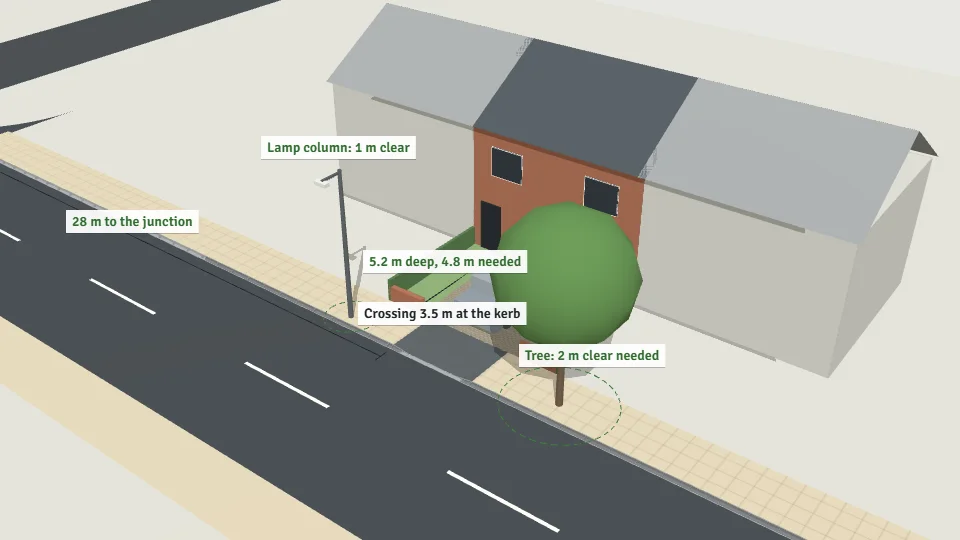
- Fee: London Borough of Waltham Forest charges £475 to apply, not refunded, plus £400 for the conditional legal agreement.
- Space: a parking space at least 4.8 m deep and 2.5 m wide.
- Junctions: at least 10 m from a junction, 8 m at the very least.
- Who builds it: Waltham Forest builds the crossing itself.
- Decision: An officer visits and, if suitable, emails an estimate; the frontage must be finished to the policy within 3 months of a provisional approval.
Waltham Forest’s rules, one by one
| Rule | What Waltham Forest asks | Source |
|---|---|---|
| Depth of the space | At least 4.8 m at right angles from the boundary to the nearest part of the house, counting steps, bays and planters. | LBWF application guidance, Guidance, A1; policy, front garden depth |
| Width of the space | The crossover is at least 2.5 m wide at the back of the footway (3.5 m on the kerb line) and at most 3.5 m (4.5 m on the kerb line) for one property. | LBWF application guidance, Guidance, A4 (minimum width at the back of the footway) |
| The crossing it builds | At least 2.5 m at the back of the footway and 3.5 m on the kerb line, at most 3.5 m and 4.5 m; the council fixes the size and position. | LBWF application guidance, Guidance, A4 |
| Distance from a junction | At least 10 m from any junction, side road or commercial access; 8 m at the very least, on safety grounds. | LBWF application guidance, Guidance, A6 |
| Street trees | At least 2 m from the base of a tree to the top of the ramped kerb; healthy trees are not removed, and a tree with a preservation order means likely refusal. | LBWF application guidance, Guidance, A9; policy, trees |
| Street lights | Lamp columns, posts, bollards, signs, poles, vent pipes and utility plant at least 1 m from the top of the ramped kerb; nearer items can be moved at your full expense. | LBWF application guidance, Guidance, A8 |
| Other street furniture | Posts, bollards, signs, poles, vent pipes and utility plant at least 1 m from the top of the ramped kerb; nearer items can be moved at your full expense. | LBWF application guidance, Guidance, A8 |
| Parking bays and laybys | In a controlled parking zone removing a space needs a traffic order change after consultation; losing more than one on-street space counts as an adverse impact. | LBWF application guidance, Guidance, A13; policy, parking arrangements |
| Grass verges | Grass verges or planted areas in front of the property must be less than 3 m deep in total. | LBWF application guidance, Guidance, A7 |
| A second crossing | A larger property may have two crossings with at least 4.8 m of undropped kerb between them, and usually a wall or fence between the entrances. | LBWF policy 2022, Policy, dimensions |
| In front of the door | Not where the only space is directly in front of the main door, following London Fire Brigade advice; the parked car stays at least 1 m from any door. | LBWF application guidance, Guidance, A14; policy, siting |
| Planting in the front garden | At least half of the front area must stay soft landscaping: lawn, beds or borders, not tubs. | LBWF application guidance, Guidance, A3; policy, permeable hardstanding |
| Driving straight in | The car must enter and leave at right angles in one movement, with no adjusting on the highway. | LBWF application guidance, Guidance, A5 |
| Gates | Gates must not open outwards over the footway or road; on principal roads gates are unlikely to be allowed. | LBWF application guidance, Guidance, A11 (Highways Act 1980, s.153) |
| Drainage | Water must not drain on to the highway: fall back to a soakaway or planting, or a channel at the threshold. | LBWF policy 2022, Policy, permeable hardstanding |
| The drive surface | All hard standing where a car parks must be permeable; a surface water test is done with an officer before construction. | LBWF application guidance, Guidance, C3 |
| Loose gravel | No unbound gravel under 20 mm; larger gravel needs a 1 m border at the threshold. | LBWF policy 2022, Policy, permeable hardstanding |
| Permission from the owner | You must own the property; tenants and leaseholders need written consent from the housing section, estate management or landlord. | LBWF dropped kerbs page, Dropped kerbs page, who can apply |
What it costs in Waltham Forest
| What you pay | Amount | Source |
|---|---|---|
| Application fee | £475 | LBWF dropped kerbs page |
| Conditional legal agreement | £400 | LBWF dropped kerbs page |
| Building the crossingConstruction is charged per square metre of crossover In a controlled parking zone the traffic order change costs at least £3,500 (the guidance also gives £3,660), with no refund and no guarantee. | £600 a m² | LBWF dropped kerbs page |
Waltham Forest builds the crossing itself. The council builds every crossover with its term contractor, after full payment and once your front garden works are finished.
Applying, and what happens next
- Every applicant signs a conditional legal agreement, registered as a local land charge, that binds later owners.
- An officer visits and, if suitable, emails an estimate; the frontage must be finished to the policy within 3 months of a provisional approval.
- Estimates are valid for 3 months.
- The decision is final; there is no appeal.
Planning permission in Waltham Forest
The highway consent and planning permission are separate. Nationally, an access on to an unclassified road and a porous or drained hard surface are permitted development for a house; Waltham Forest adds:
- Waltham Forest says planning permission is needed on a classified road, for a listed building, a flat or maisonette, in a conservation area, or for more than 5 m² of non-permeable surface; it can advise when you apply. (LBWF dropped kerbs page)
Also worth knowing in Waltham Forest
- If any part of a car sits beside the fully flat section of a dropped kerb, a penalty charge can be issued; not beside the sloping part alone. (LBWF dropped kerbs page)
- Driving over a kerb without a crossover can lead to a formal notice; ignoring it risks a fine of up to £1,000 plus the council’s costs. (LBWF dropped kerbs page)
Questions
Does Waltham Forest refund the fee if it refuses?
No. The £475 is not refunded, so check the frontage against the rules first.
Can I use my own contractor in Waltham Forest?
The council builds every crossover with its term contractor, after full payment and once your front garden works are finished.
How long is a Waltham Forest approval valid?
Estimates are valid for 3 months.
Related
- Check your driveway in 3DEvery rule for your council, in 3D.
- Dropped kerb rules comparedDepth, width, splays, junctions, trees.
- What it costsFees from £55.06 to £500, and the works.
- Havering rules and fees£261 to apply, a space 4.8 m deep.
- Hertfordshire rules and fees£139 to apply, a space 5 m deep.
- Surrey rules and fees£383 to apply, a space 4.8 m deep.
Sources: London Borough of Waltham Forest, Dropped kerbs (last updated 27 May 2026); London Borough of Waltham Forest, Vehicle Crossover Application Guidance; London Borough of Waltham Forest, Domestic Vehicle Crossover Policy (March 2022); all read on 11 October 2026. National rules: Highways Act 1980, s.184, GPDO 2015, Part 2 Class B and Part 1 Class F. legislation.gov.uk and GOV.UK content is used under the Open Government Licence v3.0; council figures are quoted as facts with their source, not copied text. Not legal advice and not a decision: the council decides after its own site visit. Not affiliated with any council or government department.