Dropped kerb refused? The usual reasons and what to do
Councils usually refuse a dropped kerb because the front garden is too shallow for a car, the access is too near a junction or a crossing, walls or hedges block the view, a street tree or lamp column is in the way, or a parking bay would be lost. Find the rule behind the reason, fix what you can, and ask for a review where the council offers one.
Refusal reasons and review routes from the councils’ own pages, read on 11 October 2026.
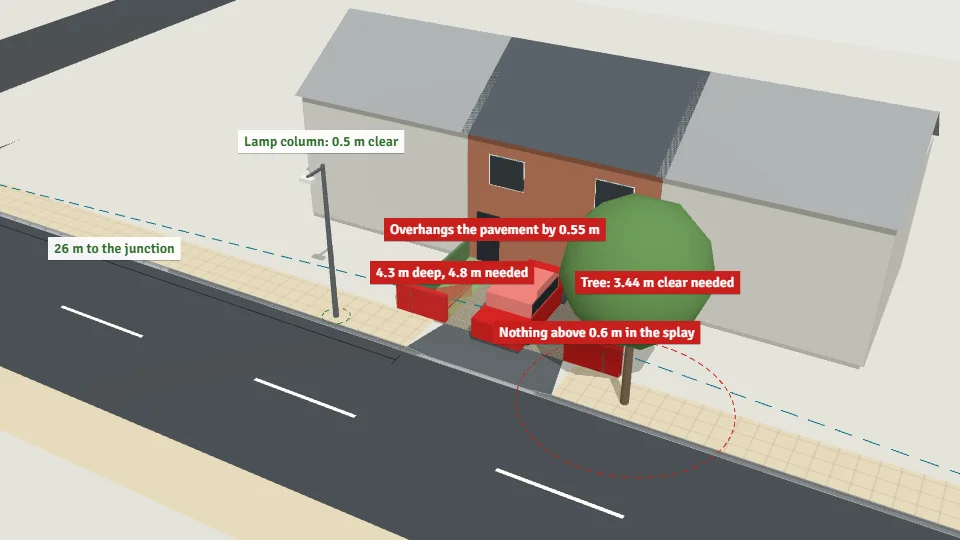
- Depth: the most common reason; a car may not overhang the footway, so the council plans for any car, not yours.
- Junctions and crossings: within 10 m to 15 m of a junction, or a controlled crossing’s zig-zags.
- Visibility: walls, fences or hedges above 0.6 m beside the opening.
- Trees and street lights: inside the root protection area, or too close to a column that cannot move.
The reasons councils give
Lancashire lists its reasons plainly: a bend or junction, nearby traffic signals, a tree that would have to go, a steep slope, the zig-zags of a crossing, a refuge or island in the way of the turn, a bus stop, a change to parking bays, poor visibility for the speed of the road, or less than 4.8 m of space. Essex adds insufficient frontage and nearby street furniture; Bristol adds a street lamp or furniture blocking the access.
What you can change
- Lower a wall, fence or hedge to 0.6 m inside the splay.
- Move the opening along the frontage, away from a tree, a lamp column or the junction.
- Pay to move a street light where the council allows it: £500 to £3,000 in Lancashire, upwards of £1,500 in Surrey.
- Use a permeable surface, or drain the drive to the garden, which answers both the drainage and the planning questions.
- Get planning permission first where the road is classified.
Reviews and appeals, council by council
| Council | After a refusal |
|---|---|
| Kent | A refusal letter sets out the reasons; if you think the criteria were applied wrongly you can ask for a review by making a complaint. |
| Essex | The council explains a refusal in writing; the initial fee is non-refundable. |
| Hampshire | A refusal letter gives the reasons. The fee is not refunded, including for the Fast Track service. |
| Surrey | You can ask for a review by a senior engineer, setting out why the criteria were applied wrongly; the aim is a reply within 10 working days, and that decision is final. |
| Hertfordshire | A senior manager reviews every refusal before it is sent. You can appeal in writing within six months if you think the policy was applied wrongly, not because you disagree with it. |
| Lancashire | A refusal is explained in writing. Half the fee is refunded. |
| Birmingham | The policy gives no right of appeal, and the application fee is not refunded. |
| Leeds | Not stated on the page; there is no guarantee a crossing will be permitted. |
| Manchester | Not stated on the pages. |
| Sheffield | The council may refuse any application; the fee is not refunded. |
| Bristol | Not stated. Granting the licence does not mean a crossing is technically achievable. |
| Havering | Refusal reasons are given in writing; appeals go through the council’s complaints process. |
| Waltham Forest | The decision is final; there is no appeal. |
If the council’s complaints process does not resolve it, the Local Government and Social Care Ombudsman looks at complaints about councils (www.lgo.org.uk).
Questions
Can I appeal a dropped kerb refusal?
It depends on the council. Hertfordshire takes written appeals within six months, Surrey has a senior engineer review the decision and aims to reply within 10 working days, and Kent and Havering use their complaints process; Birmingham and Waltham Forest give no right of appeal.
Do I get my money back if my dropped kerb is refused?
Usually not. Kent refunds £231 of £500 and Lancashire half of its £290; the other councils checked here that charge a fee keep all of it, which is why it pays to check the published rules first.
Related
Sources: LCC things to consider; Essex Highways page; BCC dropped kerbs page; each council’s review route from its own page, linked from its page here; read on 11 October 2026. legislation.gov.uk and GOV.UK content is used under the Open Government Licence v3.0; council figures are quoted as facts with their source, not copied text. Not legal advice and not a decision: the council decides after its own site visit. Not affiliated with any council or government department.