Do you need planning permission for air conditioning or a heat pump?
In England an air source heat pump, including one that also cools, needs no planning permission if its outdoor unit is no bigger than 1.5 m³, it meets the MCS 020 a) limit of 37 dB(A) at the neighbour’s window and the other conditions of Class G; a unit used only for cooling is not covered. In Ireland Class 2(d) allows a heat pump of up to 2.5 m² with a 43 dB(A) noise limit.
Rules as of 10 October 2026. England: Part 14, Class G as amended by S.I. 2025/560. Ireland: Class 2(d) as substituted by S.I. No. 342 of 2026.
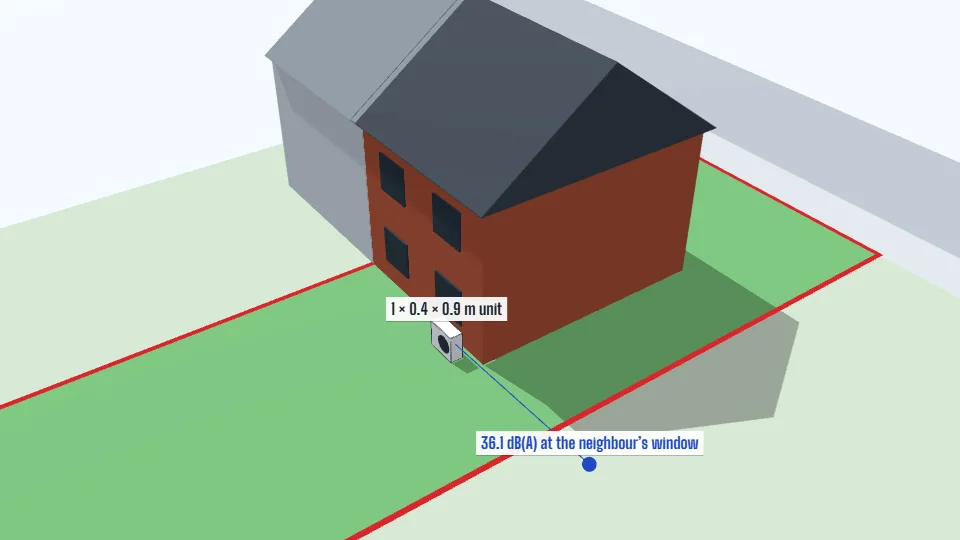
- England: outdoor unit up to 1.5 m³ with any housing, up from 0.6 m³ (G.2(d), since 29 May 2025).
- England: one heat pump at a house that is not detached, two at a detached house (G.2(a)).
- England: no 1 m boundary limit any more, but 37.0 dB(A) at the assessment position under MCS 020 a) (G.1).
- England: heating and cooling is fine, cooling only is not (G.3(aa)).
- Ireland: 2.5 m² in total, 50 cm from the edge of a wall or roof, not over a public road, 43 dB(A) or background plus 5 (Class 2(d)).
England: every condition of Class G
| The rule | Where it is in the law |
|---|---|
| The heat pump must comply with MCS 020 a): the sound level at the assessment position (1 m outside a neighbour’s habitable-room door or window) must be 37.0 dB(A) or less. | GPDO 2015, Part 14, Class G, G.1 |
| No more than one air source heat pump at a house that is not detached, or two at a detached house. | GPDO 2015, Part 14, Class G, G.2(a) |
| Not where a wind turbine is installed on the building or within the curtilage. | GPDO 2015, Part 14, Class G, G.2(b) and G.2(c) |
| The outdoor compressor unit, with any housing, must not exceed 1.5 m³ at a house (0.6 m³ at a block of flats). | GPDO 2015, Part 14, Class G, G.2(d) |
| Not on a pitched roof; on a flat roof, not within 1 m of the roof’s external edge. | GPDO 2015, Part 14, Class G, G.2(f) and G.2(g) |
| Not on a site designated as a scheduled monument. | GPDO 2015, Part 14, Class G, G.2(h) |
| Not on a listed building or within its curtilage. | GPDO 2015, Part 14, Class G, G.2(i) |
| In a conservation area or World Heritage Site: not on a wall or roof that fronts a highway, and not nearer to a highway bounding the curtilage than the nearest part of the house. | GPDO 2015, Part 14, Class G, G.2(j) |
| Elsewhere: not on a wall that fronts a highway above the level of the ground floor storey. | GPDO 2015, Part 14, Class G, G.2(k) |
| The heat pump must not be used solely for cooling. Since 29 May 2025 it no longer has to be used solely for heating, and the 1 m boundary limit has gone. | GPDO 2015, Part 14, Class G, G.3(aa) |
| Sited, so far as practicable, to minimise its effect on the appearance of the building and the amenity of the area, and removed when no longer needed. | GPDO 2015, Part 14, Class G, G.3(b) to (d) |
The MCS 020 a) sound check
Class G requires the heat pump to comply with MCS 020 a). The installer works out the sound level at each assessment position, 1 m outside the window or door of a neighbour’s habitable room: the unit’s sound power level, plus 10 log10(Q / 4πr²) for the reflecting surfaces Q and the distance r, minus any barrier. The result, rounded to 0.1, must be 37.0 dB(A) or less.
The standard’s worked example: a 60 dB(A) unit on the ground against one wall (Q4), 8.0 m from a bedroom window, with a brick wall partly hiding it (5 dB): 31.96, so 32.0 dB(A), which passes. The checker runs the same formula on your figures; your installer’s completed table is the record that counts.
Ireland: Class 2(d)
| The rule | Where it is in the law |
|---|---|
| The ground level must not be raised or lowered by more than 1 m. | Regulations 2001, Class 2(d), condition 1 |
| The heat pump, with any other heat pump already installed, must not exceed 2.5 m² in total area. | Regulations 2001, Class 2(d), condition 2 |
| A unit mounted on a wall or roof must be at least 50 cm from any edge of that wall or roof. | Regulations 2001, Class 2(d), condition 3 |
| It must not encroach onto a public road. Since 27 July 2026 it no longer has to be at the rear. | Regulations 2001, Class 2(d), condition 4 |
| Noise must not exceed 43 dB(A) in normal operation, or 5 dB(A) above background noise if that is greater, measured from the nearest neighbouring inhabited dwelling. | Regulations 2001, Class 2(d), condition 5 |
| The class covers a ground heat pump system or an air source heat pump. It does not describe a unit used only for cooling. | Regulations 2001, Class 2(d), column 1 |
Before 27 July 2026 a heat pump could not be on, or forward of, the front wall or roof of the house. Now it must only not encroach onto a public road. Apartments are outside Class 2 (article 5(1)).
Questions
Do you need planning permission for air conditioning in the UK?
In England, Class G permits an air source heat pump that heats, or heats and cools, within its limits. A unit used solely for cooling is not covered by Class G (paragraph G.3(aa)), so ask the council whether it needs planning permission. Wales, Scotland and Northern Ireland have their own rules.
How close to the boundary can a heat pump be in England?
There is no longer a distance limit: the 1 m rule was removed on 29 May 2025. The unit must meet the MCS 020 a) sound limit of 37.0 dB(A) at the neighbour’s window, and on a flat roof it must be at least 1 m from the roof’s edge.
Can a heat pump go at the front of the house in Ireland?
Yes, since 27 July 2026, as long as it does not encroach onto a public road and meets the 2.5 m², 50 cm and noise conditions of Class 2(d).
Related
- England and IrelandCheck your project in 3DThe free checker, condition by condition.
- IrelandThe new exemptions of 27 July 2026Every class that changed, old and new limits.
- EnglandHow far can I extend?3 m, 4 m, 6 m and 8 m, and side extensions.
- EnglandGarden rooms: the 2.5 m ruleHeight near a boundary, the 50% rule, uses.
- EnglandLawful development certificates£274, 8 weeks, the documents.
Sources: GPDO 2015, Schedule 2, Part 14; S.I. 2025/560; MCS 020 a) Issue 1.1; S.I. No. 342 of 2026. Irish Statute Book content is used under the Oireachtas (Open Data) PSI Licence, which incorporates CC BY 4.0. Last checked 10 October 2026. legislation.gov.uk and GOV.UK content is used under the Open Government Licence v3.0. This page is not legal advice and not a formal decision; it is not affiliated with any council or government department.