Garden room without planning permission: the 2.5 m rule and the rest of Class E
In England a garden room needs no planning permission if it is no higher than 2.5 m when any part is within 2 m of a boundary (3 m elsewhere, or 4 m with a dual-pitched roof), its eaves are no higher than 2.5 m, it has one storey, it sits behind the front of the house, and with other buildings it covers no more than half the garden.
Rules as of 10 October 2026. GPDO 2015, Schedule 2, Part 1, Class E.
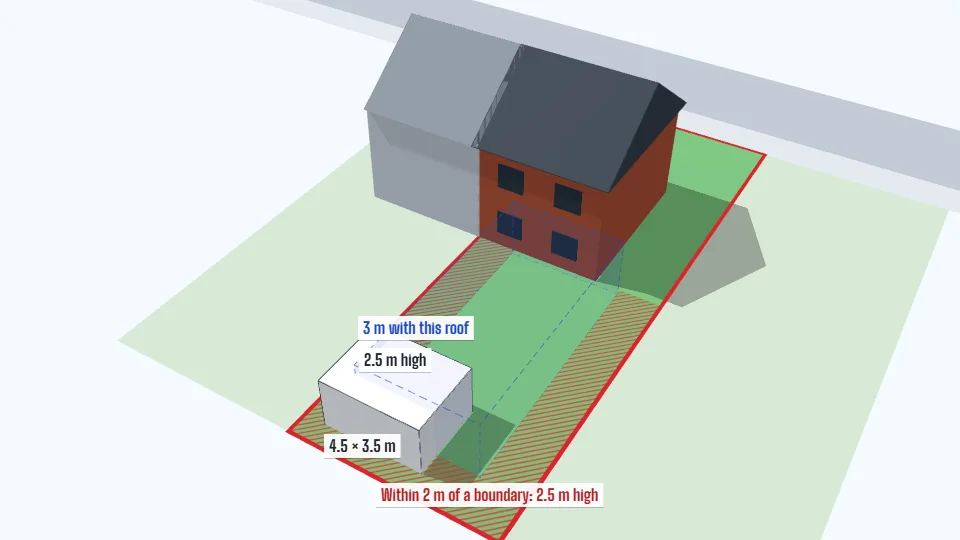
- Within 2 m of a boundary: no more than 2.5 m high (E.1(e)(ii)).
- Elsewhere: 4 m with a dual-pitched roof (hipped counts, per the technical guidance), 3 m for any other roof (E.1(e)(i), (iii)).
- Eaves no higher than 2.5 m, whatever the total height (E.1(f)).
- Single storey, behind the principal elevation, and with all other buildings no more than half the curtilage (E.1(b) to (d)).
- For a purpose incidental to the house: not a bedroom, kitchen or separate accommodation.
Every condition of Class E
| The rule | Where it is in the law |
|---|---|
| Not available where the house exists only through a change-of-use right in Part 3 or was built under Part 20. | GPDO 2015, Class E, E.1(a) and E.1(k) |
| Only for a purpose incidental to the enjoyment of the house. Separate self-contained accommodation, or a bedroom, bathroom or kitchen used as primary living space, is not covered. | GPDO 2015, Class E, E(a) and E.1(i) |
| Buildings, enclosures and containers, other than the original house, must not cover more than half of the curtilage (excluding the original house’s footprint). | GPDO 2015, Class E, E.1(b) |
| No part may be forward of a wall forming the principal elevation of the original house. | GPDO 2015, Class E, E.1(c) |
| A single storey only. | GPDO 2015, Class E, E.1(d) |
| Within 2 m of a boundary: no more than 2.5 m high. Elsewhere: 4 m with a dual-pitched roof (hipped counts, per the technical guidance), 3 m for any other roof. | GPDO 2015, Class E, E.1(e) |
| Eaves no higher than 2.5 m. | GPDO 2015, Class E, E.1(f) |
| Not within the curtilage of a listed building. | GPDO 2015, Class E, E.1(g) |
| No verandah, balcony or raised platform (over 0.3 m high). | GPDO 2015, Class E, E.1(h) |
| In a National Park, National Landscape (AONB), the Broads or a World Heritage Site: no more than 10 m² of buildings more than 20 m from any wall of the house. | GPDO 2015, Class E, E.2 |
| On article 2(3) land: nothing between a side wall of the house and the boundary. | GPDO 2015, Class E, E.3 |
Home office, gym or annex?
Class E covers a building for a purpose incidental to the enjoyment of the house. The technical guidance gives garden sheds, storage, garages and decking as examples, and says a purpose incidental to the house would not cover separate self-contained accommodation, or primary living accommodation such as a bedroom, bathroom or kitchen. A home office, gym or studio used by the household fits; a bedroom or an annex does not.
Heights are measured from the highest ground next to the building. Decking counts as a raised platform if it is more than 0.3 m high, which Class E does not allow.
Building regulations
- A detached single-storey building of up to 15 m² with no sleeping accommodation is exempt from the building regulations (Class 6, paragraph 3).
- Up to 30 m² it is also exempt if it has no sleeping accommodation and is at least 1 m from every boundary or built substantially of non-combustible material (Class 6, paragraph 1).
- A garden room with sleeping accommodation is not exempt, whatever its size.
Questions
How close to the boundary can a garden room be without planning permission?
Any distance, but if any part is within 2 m of a boundary of the curtilage, the whole building can be no higher than 2.5 m (paragraph E.1(e)(ii)).
What is the biggest garden room without planning permission?
There is no fixed floor area: buildings other than the original house must not cover more than half of the curtilage, excluding the house’s footprint. Height is 2.5 m within 2 m of a boundary, otherwise 3 m, or 4 m with a dual-pitched roof, with eaves no higher than 2.5 m.
Can I sleep in a garden room?
Not under Class E: a bedroom is primary living accommodation, not a purpose incidental to the house. A garden room with sleeping accommodation also needs building regulations approval, whatever its size.
Related
- England and IrelandCheck your project in 3DThe free checker, condition by condition.
- EnglandHow far can I extend?3 m, 4 m, 6 m and 8 m, and side extensions.
- EnglandLawful development certificates£274, 8 weeks, the documents.
- IrelandShed or garden room: 30 m²Height, position and use.
- England and IrelandAir conditioning and heat pumpsThe 2025 English rules and Class 2(d).
Sources: GPDO 2015, Schedule 2, Part 1, Class E; MHCLG technical guidance; Building Regulations 2010, Schedule 2. Last checked 10 October 2026. legislation.gov.uk and GOV.UK content is used under the Open Government Licence v3.0. This page is not legal advice and not a formal decision; it is not affiliated with any council or government department.