Lawful development certificate: proving your project needs no planning permission
A lawful development certificate for proposed works is the council’s formal confirmation that a project in England is lawful, for example because it is permitted development; for householder works it costs £274 from 1 April 2026, and the council must decide within 8 weeks of a valid application.
Rules as of 10 October 2026. Town and Country Planning Act 1990, section 192; DMPO 2015, article 39; Fees Regulations 2012.
- Fee: half the planning application fee, so £274 for householder works from 1 April 2026 (regulation 11(3)(c); householder fee £548).
- Decision: within 8 weeks of a valid application, unless you agree longer in writing (DMPO 2015, article 39(10)).
- Send: the published form, a plan to an identified scale showing North, your evidence, and a statement of your interest in the land (article 39(1), (2)).
- It is optional: permitted development needs no certificate. The certificate is the council’s confirmation in writing.
- Not the same as prior approval: a larger home extension needs prior approval (£249) whether or not you also apply for a certificate.
What the law says
| Point | Rule | Source |
|---|---|---|
| What it is | A lawful development certificate for a proposed use or development (section 192 of the Town and Country Planning Act 1990) confirms that the works would be lawful. | Town and Country Planning Act 1990, section 192 |
| Fee | The fee is half the fee for a planning application for the same works (regulation 11(3)(c)). From 1 April 2026 the householder application fee is £548, so a certificate for householder works is £274. | Fees Regulations 2012, regulations 11(3)(c) and 18A; Schedule 1 |
| Documents | Apply on the published form with a plan of the land to an identified scale showing North, the evidence you have, and a statement of your interest in the land. | DMPO 2015, article 39(1) and (2) |
| Time | The council must decide within 8 weeks of a valid application, unless you agree a longer period in writing. | DMPO 2015, article 39(10) |
| Prior approval | The larger home extension prior approval fee is £249 from 1 April 2026. | Fees Regulations 2012, regulations 14(1)(zab) and 18A |
Describe the works precisely
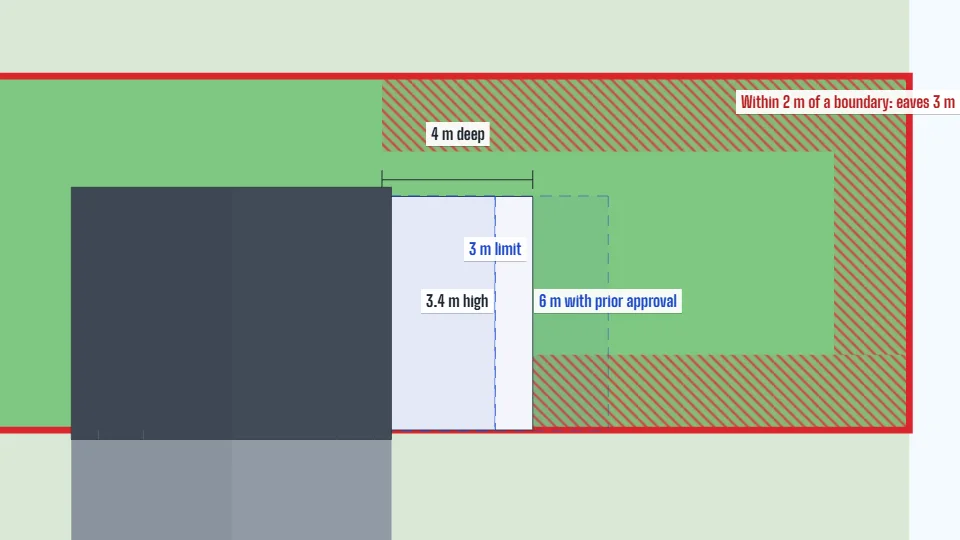
The Planning Practice Guidance asks for a precise description of what is applied for, not just the class, and enough factual information for the council to see exactly what is involved. In practice that means the dimensions that each limit is tested on: depth beyond the original rear wall, height, eaves height, distance to the boundaries, and the area of other buildings in the garden.
Pro writes the cover letter from your project, with the class and paragraphs it relies on, and a report with every limitation and condition, a dimensioned plan at a true scale and the elevations.
Questions
How much is a lawful development certificate for an extension?
Half the fee for a householder planning application. From 1 April 2026 the householder fee is £548, so a certificate for proposed householder works is £274.
How long does a lawful development certificate take?
The council must give its decision within 8 weeks of receiving a valid application, unless you agree a longer period in writing (DMPO 2015, article 39(10)).
Do I need a lawful development certificate for permitted development?
No. It is optional. It is the council’s formal confirmation that the works would be lawful, decided on the information you send.
Related
- England and IrelandCheck your project in 3DThe free checker, condition by condition.
- EnglandHow far can I extend?3 m, 4 m, 6 m and 8 m, and side extensions.
- EnglandGarden rooms: the 2.5 m ruleHeight near a boundary, the 50% rule, uses.
- England and IrelandAir conditioning and heat pumpsThe 2025 English rules and Class 2(d).
- IrelandSection 5 declarations€80, 4 weeks, what to send.
Sources: DMPO 2015, article 39; Fees Regulations 2012, regulation 11 and 18A; fees from 1 April 2026; Planning Practice Guidance. Last checked 10 October 2026. legislation.gov.uk and GOV.UK content is used under the Open Government Licence v3.0. This page is not legal advice and not a formal decision; it is not affiliated with any council or government department.