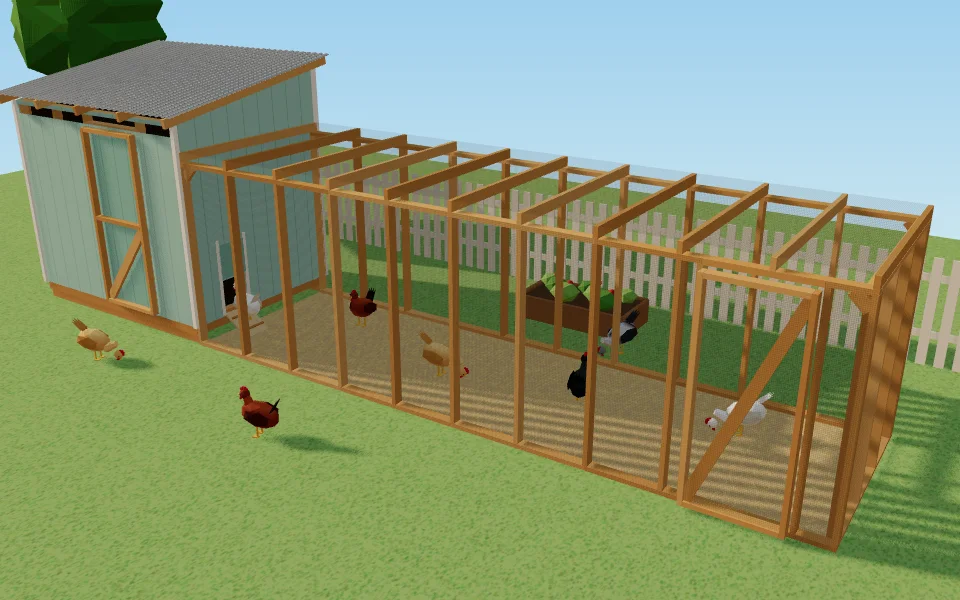
The design: a walk-in coop 8 ft by 6 ft
Twelve standard hens want 36 to 48 sq ft of house, and 8 ft by 6 ft gives 48 sq ft, with its long wall the length of one sheet of plywood. The run beside it is 20 ft by 6 ft, 120 sq ft at 10 sq ft a hen.
| Part | Size |
|---|---|
| Coop | 8 ft x 6 ft, 7 ft 6 in to 6 ft 6 in tall, floor 8 in up on skids |
| Your door | 30 in x 6 ft |
| Run | 20 ft x 6 ft, 6 ft tall, with a door |
| On the ground | 28 ft x 6 ft |
| Space a hen | 4 sq ft inside, 10 sq ft of run |
| Nest boxes | 3 x 12 in, floor 2 ft up, inside on a stand |
| Roosts | 2 x 71 in of 2x2, 30 in up |
| Vents | 691 sq in |
| Pop door | 12 in x 14 in, ramp 14 in |
| Frame | 103 boards of 2x4 |
| Hardware cloth | 5 rolls, 36 in x 50 ft |
| Apron | 12 in down, 24 in out |
| Checks | 13 of 13 fit |
Twelve is where the breed decides the coop
The same twelve birds need very different coops depending on their size. Bantams are a half to a quarter of the size of a standard chicken (Florida), and the guides give them less room: 2 to 3 sq ft inside and 5 to 8 sq ft of run against 3 to 4 and 10 for laying hens (Virginia Tech). So twelve bantams fit a hen house on legs, while twelve standard hens need the walk-in above.
| Design | On the ground | Coop floor | Run | Boards | Rolls | Checks | In the tool |
|---|---|---|---|---|---|---|---|
| Walk-in, 12 hens | 28 ft x 6 ft | 48 sq ft | 120 sq ft | 103 | 5 | Fits | Open it |
| Hen house, 12 bantams | 16 ft 10 in x 6 ft | 36 sq ft | 96 sq ft | 60 | 3 | Fits | Open it |
| Walk-in, cold winters | 28 ft x 6 ft | 48 sq ft | 120 sq ft | 103 | 5 | Fits | Open it |
The bantam house is 6 ft square on legs with 36 sq ft of floor, and its roosts sit 15 in up, inside the 12 to 18 in that Penn State gives bantams, which need only 4 in of bar each. It takes 60 boards against 103 for the walk-in.
Hard winters
Set the climate to cold winters and the walk-in keeps its size, but the roosts change: the tool lays 2x4 bars flat, wide face up, so the hens can cover their toes with their feathers against frostbite (Colorado State). The vents stay open all winter, because a coop needs air even in frigid weather to carry out moisture and ammonia (Arkansas). Wooden bars, not metal or plastic, which hold the cold (Arkansas). A heat lamp is a fire risk.
Nests and roosts for twelve
Three nest boxes at one per four hens (Oregon State), or 4 by Penn State's rule. Two roost bars of 71 in give 11 in a hen at 30 in above the floor, and the tool keeps them above the nest boxes so the hens sleep on the bars, not in the boxes, as Maryland advises; Oregon State sees it the other way round, so read the nest box guide if you build them yourself.
The material list
| Item | Quantity |
|---|---|
| Lumber | |
| 2x4 x 8 ft | 101 boards |
| 2x2 x 8 ft (roosts) | 2 boards |
| Sheet goods | |
| Plywood 15/32 in | 10 sheets |
| Plywood 23/32 in | 2 sheets |
| Hardware cloth | |
| Hardware cloth roll | 5 rolls |
| Roof | |
| Roof panels | 5 panels |
| Fasteners | |
| Roofing screws | 75 screws |
| Frame screws | 568 screws |
| Plywood screws | 448 screws |
| Staples | 1417 staples |
| Washer-head screws | 230 screws |
| Hog rings | 341 rings |
| Hardware | |
| Hinges | 5 hinges |
| Latches | 3 latches |
| Pop door kit | 1 door |