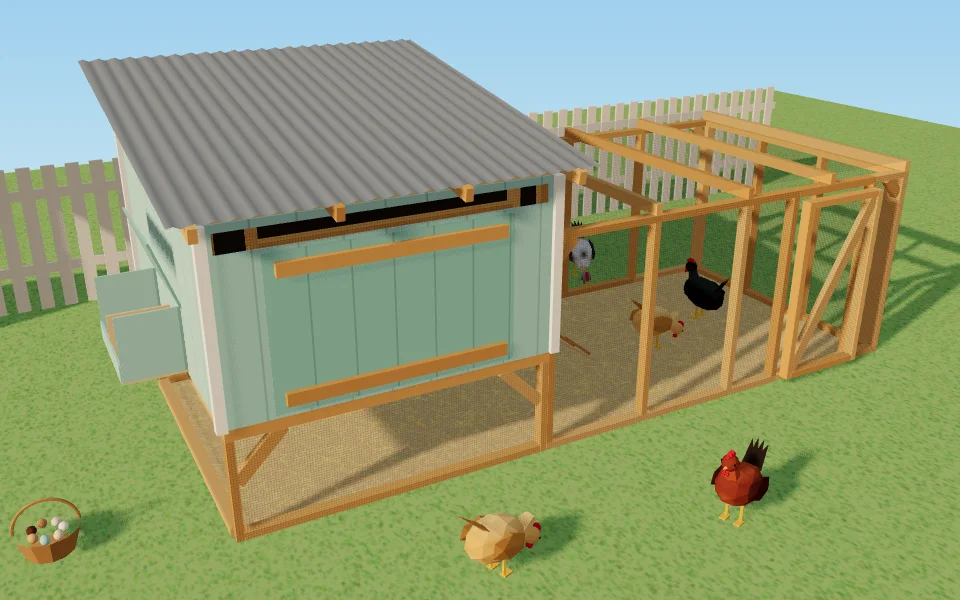
What the extension guides say
No two guides give quite the same number, because some publish minimums and others recommendations. Penn State's table is headed minimum space requirements; Virginia Tech's 2023 table is headed recommended space, and adds that you can never provide too much. Here is what each guide we read says, in its own terms.
| Guide | What it says |
|---|---|
| Virginia Tech | Laying hens: 3 to 4 sq ft inside and 10 sq ft in the run. Bantams: 2 to 3 sq ft inside and 5 to 8 sq ft in the run. |
| extension.org | Laying hens: a minimum of 3 to 4 sq ft indoors and 10 sq ft outdoors is recommended, though it notes that runs that big are not practical in many town yards. |
| Oregon State | At least 3 sq ft a bird when the hens can get out to a run, and 8 to 10 sq ft a bird when they cannot. |
| Florida | A house of at least 3 sq ft of floor a bird; a run of 8 to 10 sq ft a bird. |
| Delaware | At least 2 to 3 sq ft a chicken inside, and another 8 to 10 sq ft in the run. |
| Cornell, Warren County | A minimum of 2.5 to 3.5 sq ft a bird inside, and another 4 to 5 sq ft in the fenced area outside. |
| Maine | About 3 sq ft a bird for hens, or 2 to 3 sq ft, which can include an outside run. |
| Kentucky, on extension.org | From 0.75 to 1 sq ft a bird for small breeds to 3 to 3.5 sq ft for larger ones. |
| Penn State | Minimums: laying hens 1.5 sq ft inside and 8 in the run; large chickens 2 and 10; bantams 1 and 4. |
| Maryland | The same minimums, from Clauer (2009): 1.5 and 8 for laying hens, 2 and 10 for large chickens, 1 and 4 for bantams. |
Read together, 3 sq ft a hen inside is where most of them meet, and 4 sq ft is the generous end. The 1.5 sq ft minimums come paired with a run of 8 sq ft or more, and Oregon State's 8 to 10 sq ft for hens with no run at all shows how much of the load the run carries. In the run, 10 sq ft a hen is the common recommendation and 4 sq ft the smallest figure anyone gives.
Coop and run size for 3 to 30 chickens
The grid below multiplies Virginia Tech's 2023 figures by the size of the flock. Each row has its own address, so a link to #for-10-chickens opens on the row for ten. Go to a flock of:
| Birds | Coop, hens | Run, hens | Coop, bantams | Run, bantams |
|---|---|---|---|---|
| 3 | 9–12 | 30 | 6–9 | 15–24 |
| 4 | 12–16 | 40 | 8–12 | 20–32 |
| 5 | 15–20 | 50 | 10–15 | 25–40 |
| 6 | 18–24 | 60 | 12–18 | 30–48 |
| 7 | 21–28 | 70 | 14–21 | 35–56 |
| 8 | 24–32 | 80 | 16–24 | 40–64 |
| 9 | 27–36 | 90 | 18–27 | 45–72 |
| 10 | 30–40 | 100 | 20–30 | 50–80 |
| 11 | 33–44 | 110 | 22–33 | 55–88 |
| 12 | 36–48 | 120 | 24–36 | 60–96 |
| 13 | 39–52 | 130 | 26–39 | 65–104 |
| 14 | 42–56 | 140 | 28–42 | 70–112 |
| 15 | 45–60 | 150 | 30–45 | 75–120 |
| 16 | 48–64 | 160 | 32–48 | 80–128 |
| 17 | 51–68 | 170 | 34–51 | 85–136 |
| 18 | 54–72 | 180 | 36–54 | 90–144 |
| 19 | 57–76 | 190 | 38–57 | 95–152 |
| 20 | 60–80 | 200 | 40–60 | 100–160 |
| 21 | 63–84 | 210 | 42–63 | 105–168 |
| 22 | 66–88 | 220 | 44–66 | 110–176 |
| 23 | 69–92 | 230 | 46–69 | 115–184 |
| 24 | 72–96 | 240 | 48–72 | 120–192 |
| 25 | 75–100 | 250 | 50–75 | 125–200 |
| 26 | 78–104 | 260 | 52–78 | 130–208 |
| 27 | 81–108 | 270 | 54–81 | 135–216 |
| 28 | 84–112 | 280 | 56–84 | 140–224 |
| 29 | 87–116 | 290 | 58–87 | 145–232 |
| 30 | 90–120 | 300 | 60–90 | 150–240 |
In metric, that is 0.28 to 0.37 m² of coop floor and 0.93 m² of run for each standard hen, and 0.19 to 0.28 m² inside and 0.46 to 0.74 m² outside for each bantam. The tool works in either unit.
A coop the tool builds for each flock
Typing a flock into Coop Designer sizes the coop at 4 sq ft a hen and the run at 10 sq ft, then checks the result against the guides above. These are the designs it makes for ten flock sizes, a hen house on legs up to eight hens and a walk-in coop above that. Each opens in the tool, where you can change any size.
| Hens | The design | Coop; run | On the ground | Nest boxes | In the tool |
|---|---|---|---|---|---|
| 3 | Hen house 3 ft x 4 ft on 2 ft legs, over a run 8 ft long | 12 sq ft; 32 sq ft | 9 ft x 4 ft | 1 | Open it |
| 4 | Hen house 4 ft x 4 ft on 2 ft legs, over a run 10 ft long | 16 sq ft; 40 sq ft | 11 ft x 4 ft | 1 | Open it |
| 6 | Hen house 5 ft x 5 ft on 2 ft legs, over a run 12 ft long | 25 sq ft; 60 sq ft | 13 ft x 5 ft | 2 | Open it |
| 8 | Hen house 5 ft 6 in x 6 ft on 2 ft legs, over a run 14 ft long | 33 sq ft; 84 sq ft | 15 ft x 6 ft | 2 | Open it |
| 10 | Walk-in coop 7 ft x 6 ft, beside a run 17 ft x 6 ft | 42 sq ft; 102 sq ft | 24 ft x 6 ft | 3 | Open it |
| 12 | Walk-in coop 8 ft x 6 ft, beside a run 20 ft x 6 ft | 48 sq ft; 120 sq ft | 28 ft x 6 ft | 3 | Open it |
| 15 | Walk-in coop 7 ft 6 in x 8 ft, beside a run 19 ft x 8 ft | 60 sq ft; 152 sq ft | 26 ft 6 in x 8 ft | 4 | Open it |
| 20 | Walk-in coop 10 ft x 8 ft, beside a run 25 ft x 8 ft | 80 sq ft; 200 sq ft | 35 ft x 8 ft | 5 | Open it |
| 25 | Walk-in coop 10 ft x 10 ft, beside a run 25 ft x 10 ft | 100 sq ft; 250 sq ft | 35 ft x 10 ft | 7 | Open it |
| 30 | Walk-in coop 12 ft x 10 ft, beside a run 30 ft x 10 ft | 120 sq ft; 300 sq ft | 42 ft x 10 ft | 8 | Open it |
What counts as coop floor
The tool counts the floor inside the hen house walls, where the hens sleep, lay and wait out bad weather. Nest boxes hung on the outside of a wall take none of it, and roost bars above the floor leave it whole. Under a hen house raised on legs, the ground stays part of the run, shaded and dry, so the tool counts it toward the run and tells you how much of the run it is.
Bantams need less, but not half
Bantams are a half to a quarter of the size of a standard chicken (Florida), yet the 2023 table still gives them 2 to 3 sq ft inside, against 3 to 4 for laying hens. Twelve bantams fit a 6 ft x 6 ft hen house on legs with 36 sq ft of floor; twelve standard hens need the 8 ft x 6 ft walk-in with 48 sq ft. Their roosts are shorter and lower too: 4 in of bar a bird, 12 to 18 in above the floor, against 6 in and 18 to 24 in for standard hens (Penn State).
Height
None of the guides sets a height for the house, but they set one for what goes in it. Roosts go 18 to 24 in above the floor and never higher than 4 ft, so heavy hens do not hurt their legs jumping down (Penn State); nest boxes go at least 2 ft off the ground (Penn State). A walk-in coop needs headroom for you instead: the tool makes its run 6 ft tall, with a full-height door.
Your yard decides the rest. Type its size into the tool and it keeps the coop and the run inside it, and says when the flock is too big for the space. Open the design for six hens.