Parking across a dropped kerb: the rules in England and Scotland
In England, where the council enforces it, you can get a penalty charge for parking beside a dropped kerb, but parking outside a home by the occupier, or with the occupier’s consent given free, is an exception, except at a shared driveway. In Scotland the national ban covers kerbs dropped for pedestrians and cyclists to cross, not those for driveways.
From the Traffic Management Act 2004, the Highway Code and the Transport (Scotland) Act 2019, read on 11 October 2026.
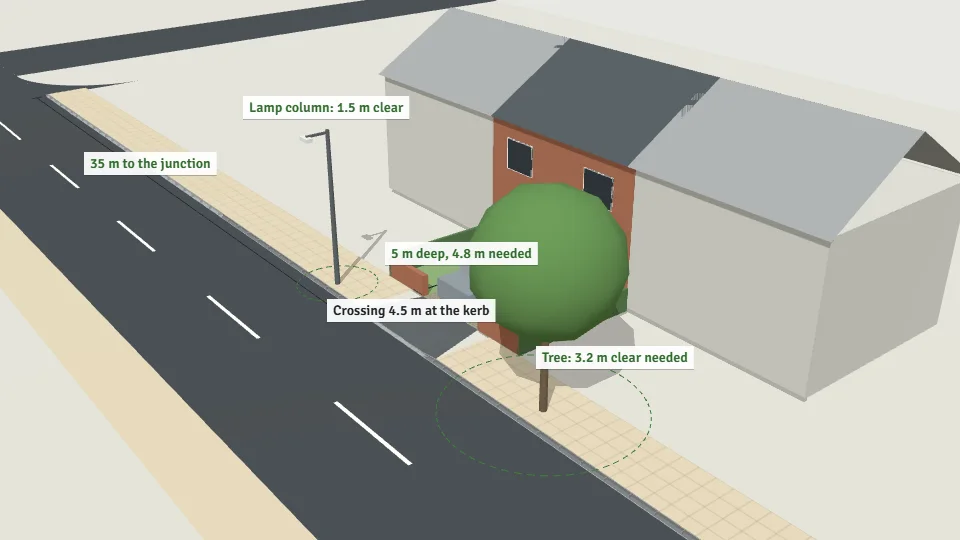
- England: In a special enforcement area, where the council enforces it, a vehicle must not be parked on the road beside a footway that has been lowered for pedestrians, cyclists or vehicles. One exception is parking outside a home by the occupier, or with the occupier’s consent given free, which does not apply to a shared driveway.
- The Highway Code: Do not stop or park in front of an entrance to a property, where the kerb has been lowered to help wheelchair users and powered mobility vehicles, or within 10 metres of a junction except in an authorised space.
- Scotland: Since 11 December 2023 parking beside a dropped kerb for pedestrians or cyclists to cross is banned, with a £100 penalty (£50 if paid within 14 days). The ban does not apply to a kerb dropped for access to a driveway or garage.
- Coming: The government said on 8 January 2026 that secondary legislation would be introduced in 2026 to let councils enforce against unnecessary obstruction of the pavement. No such instrument was on legislation.gov.uk on 11 October 2026.
England: section 86 and its exceptions
Section 86 of the Traffic Management Act 2004 applies in a special enforcement area, where the council enforces it with penalty charges. It bans parking on the carriageway beside a footway, cycle track or verge lowered for pedestrians, cyclists or vehicles, or where the road has been raised to meet it. The exceptions: wholly inside a designated parking place; outside a home by the occupier, or with the occupier’s consent given free, but not at a shared driveway; fire, police and ambulance use; deliveries and collections that cannot reasonably be done otherwise, for no more than 20 minutes; and building, demolition or excavation work, council waste collection, clearing an obstruction, and road or utility works, for no longer than necessary.
Waltham Forest says a penalty charge can be issued if any part of a car is beside the fully flat section of a dropped kerb, including a bonnet or boot overhang, but not beside the sloping part alone. Where there are no parking restrictions, Kent sends you to Kent Police on 101.
Scotland: the 2019 Act
Since 11 December 2023 councils in Scotland can issue a £100 penalty charge, reduced to £50 if paid within 14 days, for pavement parking, double parking and parking at dropped kerbs. The dropped kerb ban, in section 56, covers kerbs lowered to help pedestrians or cyclists cross; section 57(2) excludes kerbs lowered for access to a driveway or garage. The Highway Code, which covers Scotland too, still says not to park in front of an entrance to a property, and the pavement parking ban applies on its own terms.
What changes next in England
The government said on 8 January 2026 that secondary legislation would be introduced in 2026 to let councils enforce against unnecessary obstruction of the pavement. No such instrument was on legislation.gov.uk on 11 October 2026. Until then, councils enforce section 86 and their own parking restrictions; where there are none, Kent, for one, sends you to the police.
Questions
Can I park across my own dropped kerb?
In England, yes: section 86(3) of the Traffic Management Act 2004 excepts parking outside a home by the occupier or with the occupier’s consent given free, but not at a shared driveway. Some councils paint a white H marking across a dropped kerb on request; Birmingham lists it as a separate service.
Can someone park across my driveway?
Not without your consent where the council enforces section 86, so report it to the council’s parking team. Where there are no parking restrictions, Kent, for one, sends you to the police on 101.
Is it illegal to park on a dropped kerb in Scotland?
At a kerb lowered for pedestrians or cyclists to cross, yes, since 11 December 2023, with a £100 penalty (£50 within 14 days). The ban does not apply to a kerb dropped for a driveway or garage (Transport (Scotland) Act 2019, s.57(2)).
Related
- Check your driveway in 3DEvery rule for your council, in 3D.
- Dropped kerb rules comparedDepth, width, splays, junctions, trees.
- Planning permissionClassified roads, flats and the 5 m² rule.
- Waltham Forest rules and feesEnforcement at the flat section.
- Kent rules and feesReports to the police on 101.
Sources: Traffic Management Act 2004, s.86; The Highway Code, rule 243; Transport (Scotland) Act 2019, Part 6; Transport Scotland; DfT response, 8 January 2026; legislation.gov.uk search; LBWF dropped kerbs page; KCC application page; read on 11 October 2026. legislation.gov.uk and GOV.UK content is used under the Open Government Licence v3.0; council figures are quoted as facts with their source, not copied text. Not legal advice and not a decision: the council decides after its own site visit. Not affiliated with any council or government department.