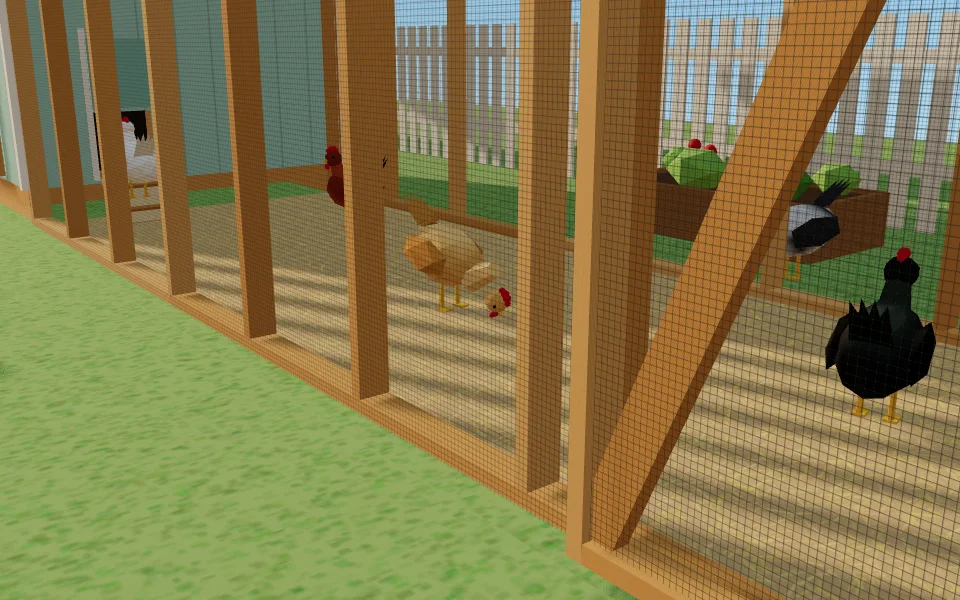
Hardware cloth or chicken wire
Chicken wire keeps hens in. It does not keep much out: Utah State's extension wildlife specialist says most predators can tear through it and rats bite through the thin wire, and recommends 1/4 to 1/2 in hardware cloth instead. UConn says to secure coops with hardware cloth, not chicken wire, and Colorado State says the same. Florida does say chicken wire gives some protection, and Colorado State finds it fine overhead as a roof against hawks, where nothing can get a grip on it.
Hardware cloth is a welded grid of galvanized steel wire, sold in rolls by its opening and its gauge. Openings matter as much as strength: raccoons reach through openings and grab at the birds inside (Maryland), so UNH asks for openings smaller than 1 in, and the smallest weasels can pass a 1/4 in hole (extension.org).
Mesh compared
The table lists the mesh we found on retailers' listings, with the opening, the gauge and the rolls as each listing gives them, and the tool's predator check of each one in the six-hen hen house, with the predators set to some. We list no prices. The lower the gauge number, the thicker the wire.
| Mesh | Opening | Gauge | Coating | Rolls listed | Check | Source |
|---|---|---|---|---|---|---|
| 1/2 in hardware cloth, 19 gauge, galvanized | 1/2 in | 19 | galvanized | 36 in x 50 ft; 24 in x 100 ft; 36 in x 100 ft | Fits | Newegg, 1/2 in hardware cloth, Do it Best, 1/2 in hardware cloth |
| 1/4 in hardware cloth, 23 gauge, galvanized | 1/4 in | 23 | galvanized after welding | 48 in x 100 ft | Fits | Do it Best, 1/4 in hardware cloth |
| 13 x 13 mm welded mesh, 19 g (1.0 mm), galvanised | 1/2 in | 19 (1.00 mm) | galvanized | 900 mm x 6 m | Fits | F.H. Brundle, 13 mm welded mesh, Screwfix, 13 x 13 mm mesh |
| 1 x 2 in welded wire, 14 gauge, galvanized | 1 in x 2 in | 14 | galvanized before welding | 48 in x 100 ft | Fits | Do it Best, 1 x 2 in welded wire |
| 2 x 4 in welded wire fence, 14 gauge | 2 in x 4 in | 14 | galvanized before welding | 48 in x 100 ft | Fail | Do it Best, 2 x 4 in welded wire |
| Chicken wire, 1 in poultry netting, 20 gauge | 1 in | 20 | galvanized | 36 in x 50 ft | Fail | AIH, 1 in poultry netting |
| 25 mm galvanised wire netting (chicken wire) | 1 in | Not stated | galvanized | 900 mm x 10 m | Fail | Screwfix, 25 mm wire netting |
Colorado State adds that you lose fewer birds behind 1 x 2 in or smaller welded wire than behind 2 x 3 in, and Oregon State builds its runs from 1 by 2 in mesh. Welded wire of that size is stronger than 19 gauge hardware cloth, but its 2 in side is wider than the 1 in UNH asks for, so the tool passes it where there are few or some predators and marks it as one to check where there are many.
The apron against digging
Foxes, dogs and raccoons dig under a run wall; the answer is hardware cloth in the ground along the bottom of every wall. The guides describe three ways:
| Method | How | Source |
|---|---|---|
| Buried straight down | At least 12 in deep with the foot turned out about 6 in. | Penn State, Virginia Tech, extension.org |
| In a trench | A trench 12 in to 1.5 ft deep round the entire coop, with hardware cloth buried in it. | Maryland |
| An L | 1 ft down and 1 ft out, in an L; Florida gives 12 to 18 in in an L. | Colorado State, Florida |
| A skirt on the surface | Laid flat outside the wall and pinned, with no digging. No guide we read gives it a width. | The tool marks it as one to check |
The tool's default is the L: 12 in down, then the rest of a 36 in roll, 24 in, laid flat under the soil outside, so the apron is cut from whole roll widths and nothing is cut lengthwise. For the six-hen hen house that is 34 ft of apron round the run. A tractor has none: it moves, so its hens are shut in the house at night.
How many rolls
The roll width decides how the walls are cut. The tool tries strips running across and running down each wall, keeps whichever needs less, overlaps each strip on the last by 1 in over a frame member, adds the apron and packs the strips onto rolls. The same four designs on three roll sizes of 1/2 in hardware cloth:
| Design | 36 in x 50 ft | 24 in x 100 ft | 36 in x 100 ft |
|---|---|---|---|
| Four-hen hen house | 2 rolls, 88 ft 2 5/8 in of strips | 2 rolls, 105 ft 8 5/8 in of strips | 1 roll, 88 ft 2 5/8 in of strips |
| Six-hen hen house | 2 rolls, 96 ft 4 5/8 in of strips | 2 rolls, 119 ft 9 5/8 in of strips | 1 roll, 96 ft 4 5/8 in of strips |
| Ten-hen walk-in | 4 rolls, 174 ft 3 in of strips | 3 rolls, 237 ft 9 in of strips | 2 rolls, 174 ft 3 in of strips |
| Twenty-hen walk-in | 6 rolls, 265 ft 11 in of strips | 4 rolls, 362 ft 9 in of strips | 3 rolls, 265 ft 11 in of strips |
Fixing it to the frame
Staple the cloth to the outside of the frame so a pushing animal presses it against the wood, not off it. The tool's shopping list counts a staple 1/2 in or longer about every 3 in along every member, a washer-head screw about every 12 in round the edge of each piece, and a hog ring or stainless zip tie every 6 in along overlaps that fall between members and where the apron meets the wall. Cut the cloth flush to a wire so no sharp ends stick out at the hens, or at you.